
Secondary keywords: CBB methodology, AI prospecting, sales cadence, consistent follow-up, CBV sales technique
The Silent Problem of B2B Prospecting
You generate leads. You feed the funnel. You track the metrics. But at the end of the month, the pipeline remains dry.
Not because there are no opportunities — there's a lack of consistent follow-up.
The numbers are relentless: 80% of B2B sales require at least 5 follow-ups to convert. However, 90% of salespeople give up after the second contact. The lead doesn't go cold because they don't want to buy. They go cold because no one follows up with them.
This gap between buying intent and effective follow-up costs millions in lost revenue every year.
What if there was a way to structure this communication systematically, combining a proven methodology with technology?
What is the CBB (or CBV) Methodology in Sales Follow-Up
The acronym CBB — or CBV (Characteristic, Benefit, and Advantage) — is a classic sales argument technique that organizes communication with the prospect into three layers:
C — Characteristic
It is the objective fact. What the product or service is. No adjectives, no opinions.
Example: "This prospecting software operates 24 hours a day, 7 days a week, across channels like WhatsApp, email, and LinkedIn."
B — Benefit
What the customer gains from this characteristic. How it solves a pain point, eliminates a problem, or generates a desired outcome.
Example: "This means your leads receive continuous attention even outside business hours, without relying on your team's availability."
V — Advantage
What makes your offer superior to market alternatives. The concrete competitive edge.
Example: "Unlike tools that only send mass messages, this system retains context memory in each interaction — the lead never has to repeat information."
Applied to follow-up, the CBB methodology transforms generic contacts into progressive value arguments, creating a ladder of engagement that naturally leads the lead to the buying decision.
Why Manual Follow-Up Fails
The average salesperson tries to manage: - WhatsApp (direct messages) - Email (proposals and reminders) - LinkedIn (connections and inMails) - Instagram (DM) - Control spreadsheets
The result is a operational chaos: leads falling through the cracks, follow-ups that never happen, messages lost in the limbo of parallel conversations.
The 15 hours a week that an SDR spends on operational tasks — copying messages, pasting, remembering who replied to what, rescheduling contacts — are hours that could be generating revenue in real conversations with qualified leads.
How to Structure a Consistent Follow-Up Cadence
A well-constructed follow-up cadence follows three principles:
1. Multichannel by Design
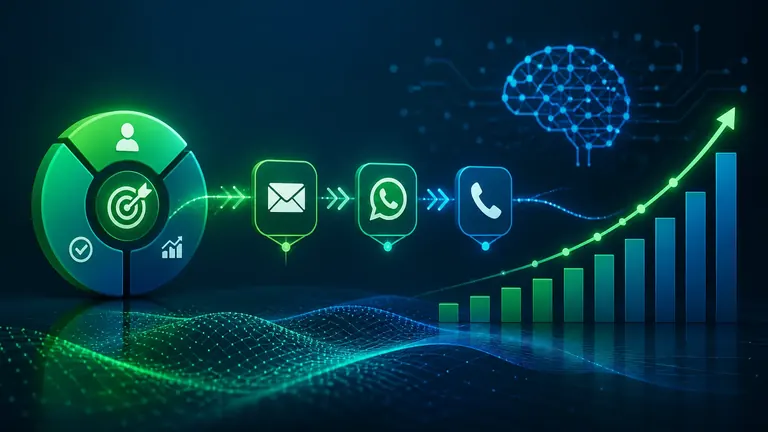
Alternating channels (WhatsApp → Email → LinkedIn → WhatsApp) increases the response rate by up to 3x compared to using a single channel. Each lead has a preferred channel — the cadence needs to discover which one it is.
2. Progression of Value
Each contact should add something new. The CBB methodology helps scale the argumentation:
| Contact | Approach |
|---|---|
| 1st | Introduction + main characteristic |
| 2nd | Specific benefit for the identified pain |
| 3rd | Case/Social proof |
| 4th | Competitive advantage |
| 5th | Offer + direct CTA |
3. Consistency Over Volume
It's no use sending 50 messages on the first day and disappearing for two weeks. A sustainable cadence — even if spaced out — beats any isolated burst of contact.
The Role of AI in Modern Prospecting
This is where technology transforms the methodology.
AI agents specialized in prospecting — like the SDR Agent — automatically apply the CBB structure, maintaining:
- Context memory: the lead never has to repeat themselves. The AI carries the conversation history across channels.
- 24/7 cadence: follow-ups continue even when the sales team is asleep.
- Progressive qualification: the AI identifies signs of interest and escalates the lead to a human at the right moment.
- Personalization at scale: each message considers the lead's stage in the funnel, without sounding generic.
The practical result? Companies that implement automated cadences with AI report increases of up to 300% in scheduled meetings and 3x higher positive response rates — not because the volume of leads increased, but because no lead dies in the limbo of follow-up.
CBB + AI: The New Standard of Prospecting
The CBB methodology hasn't changed — it remains the foundation of structured sales argumentation. What has changed is the execution capability.
Before: - Salesperson applied CBB in the first 2 contacts — and gave up - Lead received 2 messages and went cold - Unpredictable pipeline
Now: - AI sustains the CBB cadence for 10+ multichannel contacts - Lead receives complete argumentation until closing or disqualification - Predictable and measurable pipeline
The competitive edge of the future will not be who generates more leads. It will be who makes follow-up happen — every time, across all channels, without fail.
Next Steps
If you, as a sales leader or head of sales, recognize that inconsistent follow-up is costing opportunities for your company, the first step is to map your current cadence:
- How many contacts does your team make per lead before giving up?
- How many channels are used in sequence?
- Is there context memory between interactions?
- Does the lead need to repeat information?
Answering these questions already reveals where the funnel is leaking.
Want to know how to structure a multichannel cadence with AI without losing your brand's personality? Meet the SDR Agent — the prospecting agent that makes follow-up happen 24/7.