
Search intent: Informational/Commercial
Estimated volume: 🟡 medium
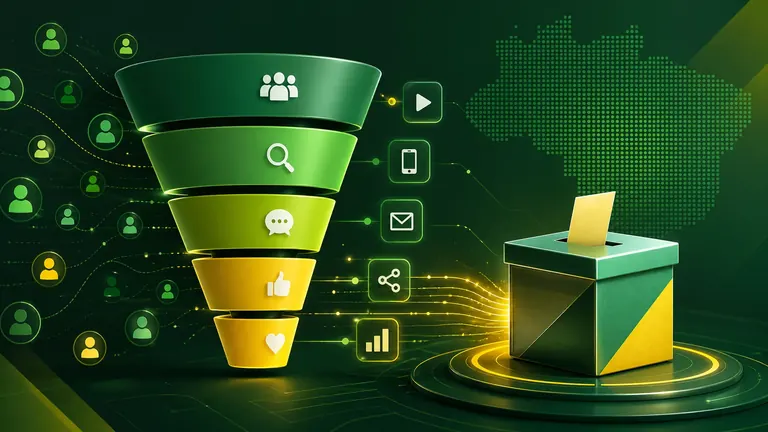
If you have ever participated in a campaign, you know this scene: dozens of posts per week, thousands of reais in boosting, events, flyers — and at the end of the month, no one knows how many voters advanced in their voting decision.
This is a campaign without a funnel. Lots of noise, little conversion.
At Kaizen Agency, we have accelerated sales for over 15 years. We build funnels for companies of all sizes, and when we apply the same methodology to political campaigns, the result is predictability. Because a political campaign is the largest sales operation that exists — the product is the candidate, the price is the vote, and the funnel is the process that transforms an unknown into a supporter.
Why a political campaign needs a funnel
A campaign without a funnel relies on feeling. And feeling lies — especially under high pressure, tight deadlines, and money at stake. The funnel solves this in three ways:
Visibility of conversion. Instead of only knowing how many people saw your post, you know how many left contact information, how many requested materials, how many confirmed their vote. Each stage has a number. And numbers don’t lie.
Resource allocation. If 10,000 people know your candidate but 200 are in consideration, you have a nurturing bottleneck — not a reach issue. Without a funnel, you would put more money into reach and worsen the imbalance.
Speed of learning. The funnel generates data at each stage. You discover which content converts and which arguments stall. The traditional campaign finds this out in October, on the eve. The funnel campaign discovers it in March and optimizes for six months.
The Kaizen analogy: sales funnel meets political funnel
Our motto: you cannot accelerate what you do not measure. Applied to the political funnel:
| Sales Funnel | Political Funnel | Action |
|---|---|---|
| Lead | Unknown | Voter has never heard of the candidate |
| MQL | Aware | Voter recognizes name and face |
| SQL | Consideration | Voter researches proposals, compares |
| Proposal | Supporter | Voter declares intention to vote |
| Closure | Vote | Voter votes for the candidate |
| Retained Customer | Militant | Voter campaigns voluntarily |
The logic is the same. What changes is the currency — from revenue to vote — and the relentless deadline: the "closure" happens in a single day, with no remarketing the following week.
The 6 stages of the political marketing funnel
Stage 1: Unknown — the voter does not know you exist
The widest stage of the funnel. Depending on the position and region, 60% to 95% of voters have never heard of the candidate.
Objective: Make the voter register the name, face, party, and a positive association.
Content: Short presentation videos (Reels, TikTok, Shorts) about a real problem. Recognition ads with geographic targeting. Participation in local events and regional media.
Key metric: Reach and name recall in qualitative surveys.
Trap: Spending the entire budget at this stage and thinking the campaign is solved with reach. Reach is the beginning, not the end.
Stage 2: Aware — the voter recognizes but does not trust
The voter knows the name, maybe the party, maybe a flag. But the voting decision is far away.
Objective: Build familiarity. The voter needs to think "this candidate understands my problem".
Content: Positioning posts on local issues. 2 to 5-minute videos deepening proposals. Testimonials from supporters and local leaders. Regional interviews and podcasts.
Key metric: Qualified engagement — comments with real questions, shares with arguments, viewing time above 60%.
📎 *Also read:* [SEO for Candidates: How to Appear on Google and Gain Voter Trust](#)
Stage 3: Consideration — the voter researches and compares
The most underestimated stage — and the most important.
In 2026, the voter considering candidates will Google the name, ask ChatGPT "which candidate supports cause X?", watch comparisons on YouTube. If you are not present in these searches with content that answers real questions, you lose the consideration stage to those who are.
Objective: Be the best answer when the voter researches. Generate conviction based on information.
Content: Website with robust SEO. Proposal articles with schema markup. Optimization for Generative AI (GEO): content that can be cited by ChatGPT, Gemini, and AI Overviews. Long videos on YouTube (8 to 20 min) with detailed arguments.
Key metric: Search traffic for name + position + cause. Time spent on the site. Return rate.
📎 *Also read:* [GEO Politics: How to Be Cited by ChatGPT, Gemini, and AI Overviews in the 2026 Elections](#)
Stage 4: Supporter — the voter declares intention to vote
The voter has decided. But between the declared intention and the ballot box, there is an abyss of forgetfulness, discouragement, and misinformation.
Objective: Transform intention into commitment. Register support and nurture until election day.
Content: Support form on the website. WhatsApp groups and Telegram channels with exclusive content. Mobilization messages and campaign updates.
Key metric: Voluntary registrations (leads). Engagement in groups. Participation in events called by direct channels.
📎 *Also read:* [WhatsApp and Telegram in the Campaign: How to Build Communities of Voters Who Vote](#)
Stage 5: Vote — the voter goes to the polls
The "closure" of the funnel. Unlike a sale, there is no second chance: if the voter gets the number wrong or gives up on the way, you lose that vote.
Objective: Ensure that the supporter votes — and votes correctly.
Actions: Reminder campaign in the 7 days prior (WhatsApp, email, SMS). Educational content about electronic voting machines and cheat sheets. Monitoring of supporter turnout. Quick counterattack against last-minute fake news.
Key metric: Attendance of registered supporters. Estimated votes by electoral zone.
Stage 6: Militant — the voter becomes a campaigner
The funnel does not end at the ballot box. The nurtured voter becomes the greatest asset: the volunteer militant who produces content, defends the candidate in groups, and convinces neighbors.
Objective: Transform voter into multiplier.
Actions: Post-election thank you. Permanent communication channels. Invitation to participate in the mandate. Ambassador program.
Key metric: Active volunteers. Engagement in mandate channels.
The right content for each stage of the funnel
The classic mistake: using the same content for all stages. The candidate records 8 minutes about tax reform and publishes it on TikTok. No one watches — the content is right for consideration but in the wrong format for the top.
| Stage | Main Format | Tone | Duration | Channel |
|---|---|---|---|---|
| Unknown | Short vertical video | Emotional, direct | 15-45 sec | TikTok, Reels, Shorts |
| Aware | Medium video + post | Informative, close | 2-5 min | Instagram, YouTube, Facebook |
| Consideration | Article, long video, website | Analytical, detailed | 8-20 min / 1,500+ words | Google, YouTube, Website, AI |
| Supporter | Direct message, group | Personal, mobilizing | Short text / 1 min audio | WhatsApp, Telegram, Email |
| Vote | Reminder + instruction | Urgent, clear | 15-30 sec | WhatsApp, SMS, ad |
| Militant | Community content | Belonging | Varied | Groups, channels, events |
Golden rule: the content matches the depth of the relationship. Deeper in the funnel = more specific and direct. Higher up = simpler and more emotional.
How to nurture political leads with automation
Capturing contacts without nurturing is throwing money away. Nurturing political leads is keeping the voter engaged by delivering the right content at the right time.
The sequence that works
Moment 0 (up to 5 min): Welcome message with what was promised. This is the peak of engagement.
Week 1 — Awareness: 3 to 4 messages about the candidate, flags, and channels. Text + short videos. No request for votes.
Weeks 2 to 4 — Deepening: Proposal and behind-the-scenes content. Invitation to WhatsApp group. Segmentation: health voters receive health content; education voters receive education content.
From week 4 — Mobilization: Active campaign. Calls, shares, surveys. In October, daily reminders.
Tools
- WhatsApp Business API + chatbot (Zenvia, Twilio, Take Blip): Scalable messaging
- RD Station / HubSpot / ActiveCampaign: Segmented email marketing and automation flows
- ManyChat / Typebot: Interactive conversational flows
⚠️ All mass communication must comply with TSE rules regarding messaging and timing. Consult the campaign's legal advisory.
Political funnel metrics: what to measure
A well-constructed funnel generates numbers. Numbers tell a story that feeling never would.
| Conversion | Calculation | Healthy Reference | Alert |
|---|---|---|---|
| Unknown → Aware | % of electorate that recognizes | Monthly growth 5-15% | Stagnation for 2 months |
| Aware → Consideration | Search traffic / total reach | 2% to 8% actively researching | Less than 1% |
| Consideration → Supporter | Registrations / website visitors | 3% to 10% conversion | Website without form |
| Supporter → Vote | Votes / registered supporters | Above 70% turnout | Below 50% |
| Vote → Militant | Volunteers / total votes | 1% to 5% | No post-election engagement |
Ignored metric: Funnel speed. If the average time from aware to supporter is 4 months and the election is in 2, you have a mathematical problem, not a marketing one.
Essential dashboard (free Looker Studio, review every Monday):
- Top: Weekly reach (organic + paid impressions)
- Middle: Qualified traffic (visits from organic search + clicks on consideration ads)
- Bottom: Captured leads (voluntary registrations)
- Closure: Confirmed supporters (declared intention to vote)
How to integrate CRM into the political funnel
If the funnel is the process and content is the fuel, the CRM is the central nervous system. Each voter becomes a record with name, contact, funnel stage, and interest segment. Without CRM, you operate in the dark.
What a political CRM needs to do
- Unified record: One record per voter, consolidating website, WhatsApp, events, and surveys
- Segmentation by stage: Tags indicating where each voter is and triggering the right communication
- Flow automation: "If a voter in consideration accessed the health page → send a video about health in 24h"
- Channel attribution: Knowing how the voter entered — organic search, ad, referral
Tools
- RD Station CRM: National, integrated with marketing automation, good cost-benefit
- HubSpot CRM: Free in the basic version, robust, advanced segmentation
- PipeDrive: Simple interface, visual pipeline, quick team adoption
- Kommo: Focused on WhatsApp, ideal for messenger-centered campaigns
- Spreadsheet + WhatsApp Business: Sufficient for campaigns with fewer than 2,000 contacts
⚠️ Never buy databases from unauthorized sources — it is an electoral crime. Every contact must come from voluntary interaction with the campaign.
Conclusion
The political marketing funnel is not a theoretical concept for presidential candidates with a budget of R$ 50 million. It is a practical tool that works for a city council candidate in a municipality of 15,000 inhabitants. The budget changes; the logic of the funnel does not.
What Kaizen Agency has learned in 15 years of accelerating sales is that predictability is built with process, not luck. A political campaign is the most intense sales operation that exists: fixed deadline, fierce competition, and a single chance to close. Doing this without a funnel is like piloting a rocket without telemetry — it might work, but you won’t know why.
If you want to build a political marketing funnel that converts voters at every stage, with a methodology tested in over 500 companies accelerated by Kaizen, talk to us.
👉 [Request a free analysis of your campaign funnel](/contato)
Frequently Asked Questions
1. Does the political marketing funnel work for a city council campaign in a small town?
Yes — and it works even better because the acquisition cost is lower and the proximity to the voter is greater. The logic is the same: map stages, produce the right content, and measure conversion. In a small town, WhatsApp is central, and vanity metrics matter less than relationship metrics.
2. What is the most neglected stage of the political funnel?
The consideration stage. Most campaigns invest heavily in reach (top) and mobilization (bottom) but ignore the middle: the moment when the voter researches, compares, and forms an opinion. This is where SEO, GEO, and deep content make a difference.
3. Do I need a paid CRM or will a spreadsheet suffice?
Up to 2,000 contacts with a small team, a well-structured spreadsheet is sufficient. Between 2,000 and 10,000, a free CRM (HubSpot, RD Station). Above 10,000, a paid CRM with integrated automation.
4. How long does it take for a voter to go through the complete funnel?
It depends on the position, region, and starting point. A well-known mayoral candidate may take 30 days from aware to supporter. An unknown state deputy, 5 months. The key is to measure the real speed of your funnel and adjust — not to find an average and hope.
5. How to integrate the funnel with TSE rules?
Explicit voter consent, clear opt-out option, transparency about boosting, and prohibition of messaging without consent. Consult legal advisory before any automation.
Suggestions for Interlinking
- [Paid Traffic for Political Campaigns: Google Ads, Meta Ads, and TikTok Ads in the 2026 Elections](#) — The funnel feeds on traffic. Read the complete guide on paid media.
- [SEO for Candidates: How to Appear on Google and Gain Voter Trust](#) — The consideration stage depends on organic search. Optimize your site.
- [WhatsApp and Telegram in the Campaign: How to Build Communities of Voters Who Vote](#) — Lead nurturing happens in messengers. Build communities.