
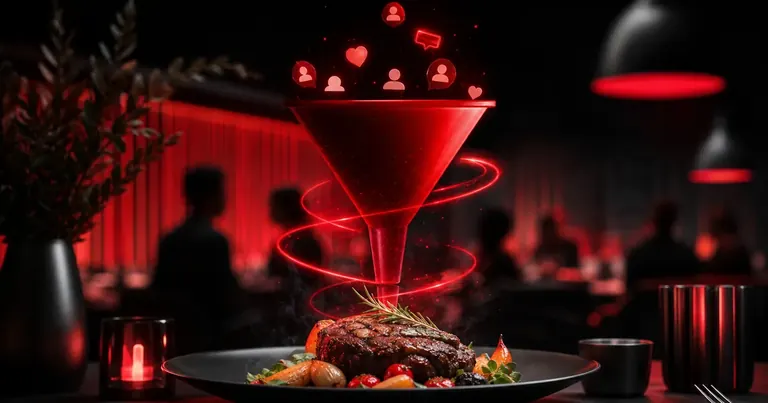
A restaurant doesn't just sell food: it sells experience, convenience, and trust. And that's exactly why inbound marketing for restaurants works better than pushing promotions every week. Instead of competing for attention with discounts, you attract those who are already hungry to discover a new place — and turn that first visit into a habit.
The logic is simple: attract with content and local presence, convert with a clear offer, delight with service, and retain through relationships. Each step feeds the next. What changes is that, in the case of a restaurant, all of this happens within a few kilometers.
Why inbound works differently for restaurants
A restaurant has an advantage that few businesses have: demand is local and recurring. People eat every day, often close to home or work. This means that the biggest opportunity is not to reach the world, but to be remembered by the neighborhood — and to be chosen again.
Ads and promotions create a spike and then cool off. Content and local presence build a memory that works every day. When someone thinks, "where should I eat today?", the restaurant that comes to mind first — and on Google — gets the customer.
1. Attract: be found at the moment of hunger
The first step is to be visible when the decision is made. This starts with a complete Google Business Profile: address, hours, menu, updated photos, and responded reviews. It’s the channel that converts the most for those searching for "restaurant near me".
Next comes the website and content. Pages like "where to have lunch in [neighborhood]" or "dinner options for couples in [region]" capture those who are already deciding. A blog with recipes, behind-the-scenes, and tips attracts those who don’t know the place yet — and plants the memory for when hunger strikes.
2. Convert: from visit to table
Attracting without converting is wasteful. Here come the most direct tools: online reservations, orders via WhatsApp, digital menus, and a unique link that resolves everything in a few taps. Each extra step reduces conversion — especially on mobile.
The entry offer needs to be clear and frictionless: a signature dish, a combo during off-peak hours, an experience that only the restaurant offers. It’s not about giving the biggest discount; it’s about providing the right reason to try it now.
3. Delight: service becomes marketing
In the restaurant, service is the product. A good experience generates spontaneous reviews, referrals, and return visits. A bad one generates public reviews that can undermine months of work.
Therefore, post-visit care is essential: thank customers, ask for reviews at the right moment, and resolve any dissatisfaction before it turns into a negative review. A well-treated customer is the cheapest acquisition channel there is.
4. Retain: turn visits into habits
Here the restaurant has an edge over any other local business: those who liked it come back — if they are remembered. Simple loyalty programs, daily dish notifications, event invitations, and birthday messages keep the restaurant present without seeming pushy.
Use the data you already have — phone numbers, WhatsApp, order history — to segment. Someone who ordered once and disappeared receives a different invitation than a regular customer. A well-used CRM and commercial automation system prevents both extremes: not bothering those who are already loyal and not forgetting those who need a nudge.
What about online reservations and orders?
Whenever possible, centralize the relationship on what is yours: website, WhatsApp, and email. Delivery apps help with volume but take the margin and customer contact. Ideally, use the app to discover and your own channel to retain.
How to measure results
Don’t just measure revenue. Track where customers come from (counter, Google, delivery, referrals), how many return within 30 days, the average ticket by source, and how many new reviews come in each month. These numbers show whether inbound is working or if it’s just vanity metrics.
Where to start
If you want to start today, do it in this order: complete your Business Profile, create a unique link for orders and reservations, define an entry offer, and start collecting contacts for reactivation later. With these four steps, the restaurant will stop relying solely on foot traffic.
To structure attracting, converting, and retaining methodically, it’s worth exploring the inbound marketing consulting from Kaizen.
Frequently asked questions
Do I need a website or is the Business Profile enough?
The Profile solves local discovery and is essential, but the website is your space for menu, reservations, and content that attracts. Ideally, both work together.
Does it work for a small restaurant with a single owner?
Yes, it works. The smaller the operation, the more important it is to take care of the Business Profile, reviews, and the return of loyal customers — because there’s no budget to compensate with ads.
How long does it take to see results?
The first gains in local presence appear within a few weeks; the habit of repurchase and content working alone matures in three to six months.
Also read: apply the same logic of inbound marketing in local services, and see what paid traffic is to accelerate discovery when you want to scale.
The role of social media and reviews
The social media of a restaurant do not exist to go viral; they exist to create hunger and show that the place is real. A dish that looks good on screen becomes desire; behind-the-scenes that show the preparation build trust. It’s not necessary to produce a lot: one dish per day, shown in good light with a simple phrase, already creates presence.
Reviews weigh even more. Ninety percent of customers read reviews before choosing where to eat, and a high rating with attentive responses from the owner is worth more than any ad. Respond to all — the good ones with gratitude, the bad ones with calm and solutions. Those who read a well-resolved complaint trust the restaurant more than those who only see five stars.
Another decisive point is consistency. It’s no use having one month of intense content and two months of silence. A minimal routine, fulfilled every week, surpasses any isolated spike. Think of content like a menu: it needs to exist all the time, not just at the opening.
Integration between channels
The most common mistake is treating each channel as an island: Google here, Instagram there, WhatsApp over there, delivery in another corner. The customer does not see channels; they see the restaurant. When someone enters the Business Profile, clicks on the website, lands on the menu, and orders via WhatsApp, this journey must be continuous and without relearning.
Standardize name, address, hours, and link across all points. A button that works on all channels reduces friction and transforms curiosity into orders. Simple, but it makes the difference between being seen and being chosen.
How much it costs and what to expect
Inbound does not require a large initial investment — most of it is organization and consistency. Costs arise from simple tools (website, automation, order link) and, when it makes sense, from paid media to accelerate local discovery. The return comes in the form of returning customers, higher ticket sizes, and less dependence on discounts.
Expecting results in a week is an illusion. What is seen quickly is more discovery on Google; what is built over months is the foundation of loyal customers that sustains the business even outside of peak season.