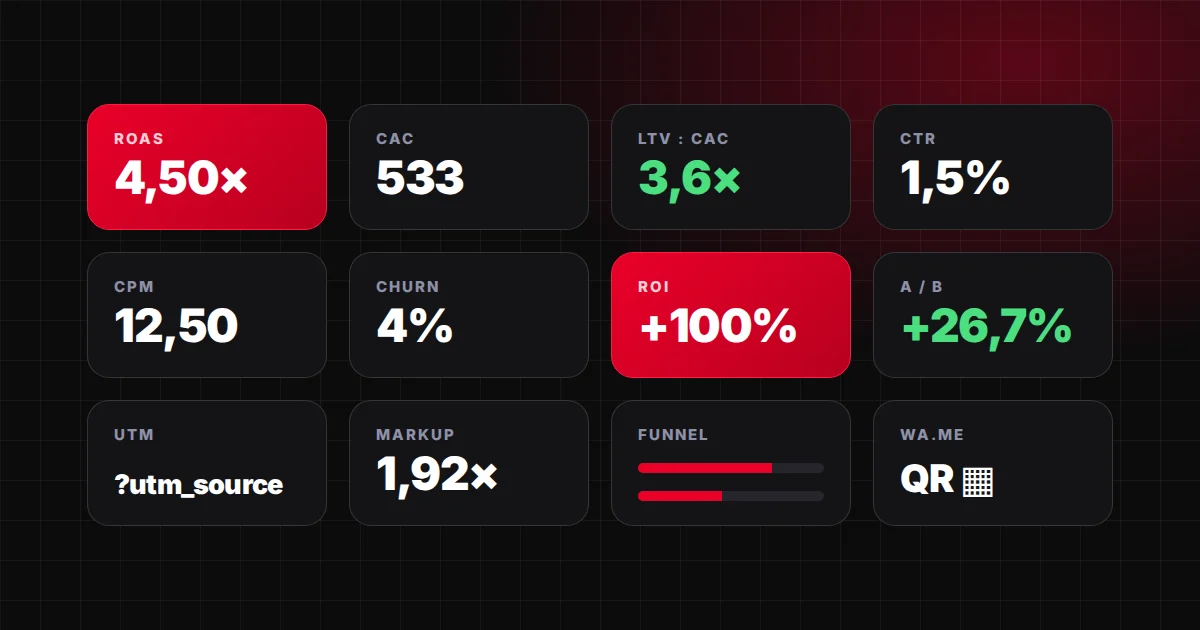
Most teams do not have a tool problem. They have a numbers problem. Dashboards are full, yet the questions that matter go unanswered: how much can we pay for a customer, and what ROAS keeps us profitable?
The right marketing tools answer those questions fast, and the right metrics tell you which answers to trust. This guide gives you both. First, a set of free marketing calculators from Kaizen Tools, organized by funnel stage, with the formula behind each one so you know exactly what you are looking at. Then a worked example of how the metrics connect, the essential tool stack, and a checklist for choosing tools.
Free Kaizen marketing calculators by funnel stage
All the calculators below are free and live on the Kaizen Tools hub of free marketing tools. Calculations run in your browser, and you can share a result with "copy link", which keeps your inputs in the URL. Only the launch projection asks for a free account.
Planning: set targets and budgets before you spend a dollar.
Sales funnel calculator
The question it answers: how many visitors, leads and opportunities do I need to hit a revenue goal, and what media budget does that take?
Formula: sales = revenue goal ÷ average ticket; opportunities = sales ÷ opportunity-to-sale rate; leads = opportunities ÷ lead-to-opportunity rate; visitors = leads ÷ visitor-to-lead rate; media budget = leads × CPL.
When to use it: quarterly planning and budget talks with finance. It works backward from the goal, so every stage gets a target. Plan your reverse sales funnel and media budget. If you need a refresher on the stages themselves, read what a sales funnel is and how it works.
Launch break-even calculator
The question it answers: how many sales does a digital launch need to cover agency fees, media and tools, and what ROAS does that imply?
Formula: average net ticket = blended ticket × (1 − platform fee − tax); break-even sales = total cost ÷ average net ticket; break-even ROAS = break-even revenue ÷ media spend.
When to use it: before committing to a course, info product or cohort launch. It blends the main offer and an entry offer by sales mix, and projects leads (media ÷ CPL) and sales (leads × conversion rate) so you can compare the projection to break-even. Calculate your launch break-even point.
Acquisition and paid media: measure what you pay for attention, clicks and customers.
CPM, CPC and CTR calculator
The question it answers: what are my real cost and efficiency metrics across campaigns, using the same definitions on every platform?
Formula: CPM = spend ÷ impressions × 1,000; CPC = spend ÷ clicks; CTR = clicks ÷ impressions; conversion rate = conversions ÷ clicks; CPA = spend ÷ conversions.
When to use it: comparing platforms side by side or sanity-checking a report. A high CPA with a healthy CTR usually points to the landing page, not the ad; a low CTR points to creative or targeting. Calculate CPM, CPC, CTR and CPA in one place.
ROAS calculator
The question it answers: is this campaign actually profitable, or does it just look good in the ad platform?
Formula: ROAS = revenue ÷ ad spend; break-even ROAS = 1 ÷ (gross margin − variable costs); break-even CPA = average order value × (gross margin − variable costs).
When to use it: setting target ROAS bids or judging ecommerce campaigns. A 4x ROAS loses money if your contribution margin is 20%, because break-even sits at 5x. Find your break-even ROAS for free.
CAC calculator
The question it answers: how much does it cost, all-in, to win a new customer?
Formula: CAC = (marketing spend + sales spend + other acquisition costs) ÷ new customers; first-order coverage = (first order × gross margin) ÷ CAC.
When to use it: monthly reporting and channel decisions. The coverage ratio shows whether the first purchase pays for acquisition; below 1, you depend on repeat purchases. Calculate your customer acquisition cost.
Unit economics and revenue: check that each customer is worth more than they cost.
LTV calculator (with LTV:CAC and payback)
The question it answers: how much gross profit does a customer generate over their lifetime, and how fast do I recover what I paid to acquire them?
Formula: for repeat purchases, LTV = average ticket × purchases per year × years retained × gross margin; for subscriptions, LTV = monthly revenue × (1 ÷ monthly churn) × gross margin. Then LTV:CAC = LTV ÷ CAC and payback = CAC ÷ monthly gross profit.
When to use it: deciding how aggressive you can be on acquisition. The common benchmark is an LTV:CAC of 3 or more, which the tool also turns into a maximum affordable CAC (LTV ÷ 3). Calculate customer lifetime value and LTV:CAC. For strategy, see our guide on how to balance CAC and LTV.
Churn rate calculator
The question it answers: how many customers and how much recurring revenue am I losing, and what does that do over a year?
Formula: churn rate = customers lost ÷ customers at the start of the period; annual churn = 1 − (1 − monthly churn)¹²; average lifetime = 1 ÷ churn; NRR = (starting MRR − MRR lost + expansion MRR) ÷ starting MRR.
When to use it: any subscription, SaaS, membership or retainer business. A 4% monthly churn sounds small until you see it compounds to roughly 39% a year. Calculate churn rate, retention and NRR. Then read our playbook on reducing churn with customer success.
Markup calculator
The question it answers: what selling price covers my unit cost, fixed expenses, variable costs and target profit?
Formula: price = unit cost ÷ (1 − fixed expenses % − variable costs % − target margin %); markup = (price − cost) ÷ cost; gross margin = (price − cost) ÷ price.
When to use it: pricing a product or a promotion. It also clears up the most common pricing mistake: a 50% markup is not a 50% margin (it is about 33%). Calculate markup, multiplier and margin.
Marketing ROI calculator
The question it answers: after margin, did this investment return more than it cost?
Formula: ROI = (revenue × gross margin − investment) ÷ investment. The tool also shows the simplified revenue-based ROI, (revenue − investment) ÷ investment, so you can see how much it overstates the return.
When to use it: reporting to leadership or justifying a budget increase. Margin-based ROI is the honest version. Calculate your marketing ROI. For the bigger picture, see how to evaluate the ROI of digital marketing strategies.
Optimization, tracking and social: prove what works and keep attribution clean.
A/B test calculator
The question it answers: is variant B really better than A, or is the difference just noise?
Formula: a two-sided two-proportion z-test on the conversion rates, giving uplift, p-value and certainty at 90%, 95% or 99% confidence, plus the sample size per variant needed for 80% statistical power.
When to use it: before you declare a winner on a landing page, email subject line or ad creative test. A result can be statistically significant and still under-powered, which is why peeking at results daily and stopping early leads to false winners. Check your A/B test significance.
UTM builder
The question it answers: how do I tag links so GA4 attributes traffic to the right source, medium and campaign?
How it works: it appends utm_source, utm_medium, utm_campaign and the optional utm_term, utm_content and utm_id to your URL, normalizes them to lowercase with hyphens, and predicts which GA4 default channel group the traffic will land in (Paid Search, Paid Social, Email and so on).
When to use it: every link in ads, emails, social bios and QR codes. Never tag internal links, and keep casing consistent: "Facebook" and "facebook" show up as two different sources. Build UTM links for GA4.
WhatsApp link generator
The question it answers: how do I create a click-to-chat link and QR code with a pre-filled message?
How it works: it cleans the phone number, adds the country code and builds a wa.me link with your URL-encoded message, plus an HTML button and a downloadable QR code. Everything is generated in the browser and the number is not stored.
When to use it: Instagram bios, click-to-WhatsApp ads, Google Business Profile and email signatures, especially if you sell to Latin America or Europe. Pair it with UTMs on the landing page to keep attribution intact. Generate a WhatsApp link and QR code.
Engagement rate calculator
The question it answers: how engaged is my audience, by followers and by reach?
Formula: interactions = likes + comments + shares + saves; engagement rate by followers = interactions per post ÷ followers; engagement rate by reach = interactions ÷ reach.
When to use it: benchmarking your content over time or vetting creators. Engagement varies by platform and account size, and smaller accounts usually post higher rates, so compare like with like. Calculate your social media engagement rate. If TikTok is on your plan, our guide to TikTok for Business covers both organic and paid.
How the metrics connect: a worked example
Each calculator answers one question. The real value shows up when you chain them, because the output of one becomes the input of the next. Here is a simple example with round numbers for a business selling a $2,000 service.
- Start with the funnel goal. You want $100,000 in new revenue next quarter. At a $2,000 ticket, that is 50 sales. With a 20% opportunity-to-sale rate you need 250 opportunities; with a 25% lead-to-opportunity rate, 1,000 leads. At a $25 cost per lead, the media budget is $25,000, which means a media-only CAC of $500 and a 4.0x ROAS on first purchases.
- Get to the full CAC. Media is not the only cost. Add $10,000 of sales team time and tools, and the all-in CAC becomes $35,000 ÷ 50 = $700.
- Check LTV:CAC. Suppose a customer buys 1.5 times a year for two years at a 60% gross margin. Revenue LTV is $6,000 and gross-profit LTV is $3,600. LTV:CAC = $3,600 ÷ $700 ≈ 5.1x, comfortably above 3x. The maximum CAC you could afford at 3x is $1,200, so there is room to scale.
- Set the break-even ROAS. With a 60% gross margin and 10% in variable costs (payment fees, taxes, commissions), contribution margin is 50%, so break-even ROAS is 1 ÷ 0.5 = 2.0x. The planned 4.0x is well above it, even before counting repeat purchases.
That chain turns "we want more revenue" into a budget, a lead target, a CAC ceiling and a ROAS floor your media team can actually bid against.
| Metric | What it measures | Formula | Tool |
|---|---|---|---|
| Funnel volume | Leads and budget needed to hit a revenue goal | Goal ÷ ticket ÷ conversion rates; leads × CPL | Sales funnel calculator |
| CAC | All-in cost to acquire one customer | (Marketing + sales + other costs) ÷ new customers | CAC calculator |
| LTV | Gross profit per customer over their lifetime | Ticket × frequency × lifetime × margin | LTV calculator |
| LTV:CAC | Whether acquisition pays off over time | LTV ÷ CAC (target ≥ 3) | LTV calculator |
| Break-even ROAS | Minimum ROAS before ads lose money | 1 ÷ (gross margin − variable costs) | ROAS calculator |
| Marketing ROI | Net return on investment after margin | (Revenue × margin − investment) ÷ investment | ROI calculator |
| Churn rate | Share of customers lost per period | Customers lost ÷ customers at start | Churn calculator |
The essential marketing tool stack
Calculators tell you what the numbers should be. The tools below are where the numbers come from and where you act on them. You need one solid option per category, connected to the others.
Analytics and tag management
- Google Analytics 4: event-based web and app analytics, and the destination for your UTM data. Free.
- Google Tag Manager: deploys pixels, conversion tags and events without a developer release for each change. Free.
- Looker Studio: dashboards that combine GA4, ad platforms and spreadsheets in one report. Free.
- Microsoft Clarity or Hotjar: heatmaps and session recordings that show why a page does not convert. Clarity is free; Hotjar has a free plan.
SEO
- Google Search Console: the only first-party source for the queries, clicks and indexing status of your site in Google. Free.
- Semrush or Ahrefs: keyword research, competitor analysis, backlinks and rank tracking. Both are paid, with limited free access.
Paid media
- Google Ads: search, Performance Max, YouTube and display. Captures existing demand.
- Meta Ads Manager: Facebook and Instagram campaigns, strong for demand creation and retargeting.
- TikTok Ads Manager: short-form video ads with competitive reach in many niches.
- LinkedIn Campaign Manager: B2B targeting by job title, company and industry. Pricier per click, often worth it for high-ticket deals.
All four are free to use; you pay only for media.
CRM and marketing automation
- HubSpot: CRM, email, forms and automation in one platform. Has a free CRM tier.
- ActiveCampaign: email marketing and automation with a strong workflow builder, popular with ecommerce and small businesses.
- Kommo: a messaging-first CRM built around WhatsApp, Instagram and other chat channels.
Your CRM is where CAC, LTV and churn actually get calculated, because it is the only place that knows which lead became which customer.
Content and design
- Canva: fast social, ad and presentation design with brand kits. Has a free plan.
- ChatGPT or Claude: AI assistants for drafts, ad copy variations, research and data analysis. Both have free tiers.
Product and CRO
- VWO or Optimizely: A/B and multivariate testing on your site. Google Optimize was discontinued in 2023, so if an older guide recommends it, look elsewhere. Validate results with the A/B test calculator before rolling out a winner.
How to choose marketing tools
A tool is only as good as the data it shares with the rest of your stack. Use these criteria before you sign up for anything:
- Integration with your CRM and analytics. If a tool cannot send conversions back to your ad platforms or leads into your CRM, you will end up exporting spreadsheets by hand.
- Data ownership and privacy compliance. Know where data is stored, who can export it and whether the vendor supports GDPR, CCPA and other state privacy laws, including consent management.
- Cost per seat and cost at scale. Many tools are cheap for one user or a small contact list and expensive as you grow. Model the cost at two or three times your current size.
- Learning curve. A powerful tool nobody on the team can use is a liability. Favor tools your team can operate weekly without a specialist.
- Measurable impact. Define the metric the tool should move, such as conversion rate, CAC or hours saved, and review it after 90 days.
FAQ
What are the best free marketing tools?
For most businesses the free core is Google Analytics 4, Google Tag Manager, Google Search Console, Looker Studio and Microsoft Clarity, plus free calculators for planning and unit economics, like the ones on Kaizen Tools.
Are the Kaizen marketing calculators really free?
Yes. All the calculators are free to use. Calculations run in your browser and you can share results through a link that keeps your inputs. Only the launch break-even projection and chart ask for a free account.
What is the difference between ROAS and ROI?
ROAS divides revenue by ad spend and ignores costs. ROI subtracts the investment from gross profit and divides by the investment, so it reflects margin. A campaign can have a 3x ROAS and a negative ROI if margins are thin, which is why break-even ROAS matters.
What is a good LTV:CAC ratio?
The common benchmark is 3:1 or higher. Below 1:1 you lose money on every customer; between 1:1 and 3:1 the business works but has little room for error. Check payback period too.
Which marketing metrics should I track first?
Start with CAC, conversion rate by funnel stage, ROAS against your break-even ROAS, and LTV or churn if you have recurring revenue. Those few numbers tell you whether growth is profitable.
Turn numbers into a performance operation
Free marketing tools get you to the right questions. Answering them every week takes clean tracking, connected data and campaigns managed against real margin targets. Agência Kaizen sets up the measurement layer (GA4, tags, CRM integration and dashboards) and runs performance campaigns built on your unit economics, not on vanity metrics. Talk to Agência Kaizen about your measurement and growth plan.