
You may have heard that "politics is done in the streets." In 2026, this phrase is incomplete.
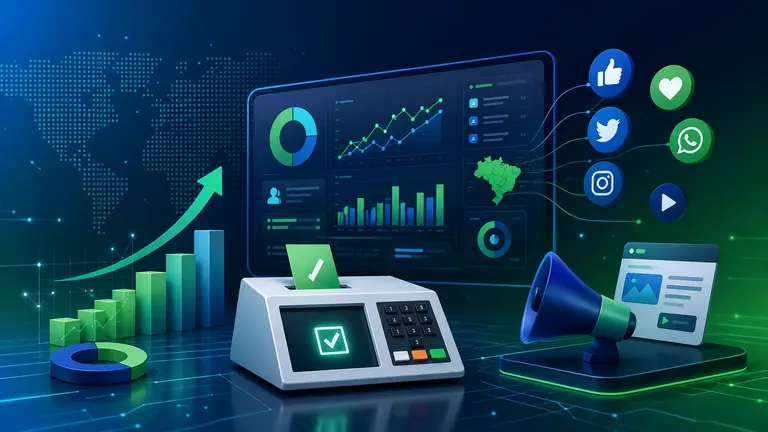
Politics is done in the streets, on Google, on TikTok, on WhatsApp, on Instagram, on ChatGPT, and everywhere the voter spends an average of 4.5 hours a day. Ignoring this is not strategy — it's a sentence of irrelevance.
Digital political marketing is no longer an "extra" in the campaign. It is the main battlefield. And, as in any battle, those who win have the best strategy, the best data, and the fastest execution.
In this guide, I will show you how digital political marketing works in 2026 — without empty jargon, without magic formulas, but with what really works.
What Changed in Digital Political Marketing
If you campaigned in 2022 and think you know how it works in 2026, stop. The game has changed on three fundamental fronts:
1. Voters Research Before Deciding
75% of Brazilian voters access news and political information through social media. But that's not all: voters actively research. They type the candidate's name into Google. They ask ChatGPT, "which candidate supports X?" They search TikTok for "health proposals" and watch videos that the algorithm delivers.
If you don't appear in these searches, you don't exist for that voter.
2. Attention Has Become More Expensive and Shorter
The cost of paid media has risen. Attention span has plummeted. In 2026, you have between 3 and 7 seconds to capture a voter's attention in the feed. If you don't hook them in that window, they scroll down — and probably won't come back.
3. Search Mechanisms Have Multiplied
Previously, Google was the only relevant search engine. In 2026, your voters search on:
- Google (still the largest, but sharing space)
- ChatGPT / Gemini / Perplexity (searches via generative AI)
- TikTok (video search, especially for voters under 35)
- Instagram (social search, hashtags, and Reels)
- YouTube (the second largest search engine in the world)
Each requires a different optimization strategy. We will discuss each of them in specific articles in this series.
The 7 Pillars of Digital Political Marketing in 2026
After analyzing dozens of campaigns, audience data, and the latest trends, I organized digital political marketing into 7 complementary pillars:
Pillar 1: SEO and Presence in Search Engines
Your campaign website needs to rank. When someone searches for your name, your cause, or your proposals, you need to appear — and not just appear, but appear with content that generates trust.
What it includes: Technical SEO, local SEO, content SEO, schema markup, Link Building.
📎 *Read the complete guide: [SEO for Candidates: How to Appear on Google](#)*
Pillar 2: GEO — Optimization for Generative AI
In 2026, some voters won't go to Google — they will ask an AI directly. GEO (Generative Engine Optimization) is the set of techniques to make your content cited by ChatGPT, Gemini, AI Overviews, and other AI engines.
What it includes: domain authority, structured data, narrative consistency, citable sources.
📎 *Read the complete guide: [GEO 2026: How to Be Cited by AI in Politics](#)*
Pillar 3: Presence on Social Media with Social SEO
Social media has become search engines. Your content needs to be findable within TikTok, Instagram, and YouTube — with keywords in captions, strategic hashtags, and scripts optimized for search.
What it includes: Social SEO, short content, live streams, behind-the-scenes, real interaction.
📎 *Read the complete guide: [Social SEO: TikTok and Instagram as Search Engines](#)*
Pillar 4: Communities and Messaging
Followers are an audience. Communities are an army. In 2026, WhatsApp and Telegram groups are where the grassroots organize, information goes viral, and the undecided are converted — away from the algorithms of open networks.
What it includes: WhatsApp groups, Telegram, broadcast lists, chatbots, political CRM.
📎 *Read the complete guide: [WhatsApp and Telegram: Communities that Vote](#)*
Pillar 5: Paid Traffic with Intelligence
Throwing money at ads without strategy is the quickest way to burn through your campaign budget. Political paid traffic in 2026 requires surgical targeting, adherence to TSE rules, and continuous ROI optimization.
What it includes: Google Ads, Meta Ads, TikTok Ads, targeting, ad copywriting.
📎 *Read the complete guide: [Paid Traffic for Campaigns in the 2026 Elections](#)*
Pillar 6: Data and Artificial Intelligence
Data is the fuel of the modern campaign. AI is the engine. From voter segmentation to message personalization, from predictive analysis to automated service — competitive campaigns in 2026 operate with technology.
What it includes: political CRM, AI for analysis, chatbots, automation, first-party data.
📎 *Read the complete guide: [Artificial Intelligence in Political Campaigns](#)*
Pillar 7: Branding, Reputation, and Narrative
Technology without narrative is waste. It is pointless to be on all channels if your message is generic, your reputation is fragile, and your candidate brand does not generate trust. Political branding in 2026 is a perception strategy.
What it includes: brand building, crisis management, cause marketing, positioning.
📎 *Read the complete guide: [Political Branding: A Brand that Generates Trust](#)*
How Kaizen Approaches Political Marketing
At Kaizen Agency, we don't believe in ready-made formulas. We are a sales accelerator — and we treat political campaigns with the same seriousness we treat operations for large brands.
What sets us apart:
- Google Partner Premier — maximum certification from Google, complete mastery of Google Ads and SEO
- Data-driven — decisions based on data, not intuition
- Proprietary Methodology — marketing funnel, lead nurturing, and CRM adapted to the political reality
- Integrated Ecosystem — SEO + Paid Media + Branding + AI + CRM + Automation, all under one roof
- 15+ years of experience — over 1,000 accelerated companies
Where to Start Your Digital Campaign
If you are a candidate just starting out, the order is:
- Plan — define voter personas, map the journey, and establish KPIs
- Build Presence — optimized website, professional social profiles, valuable content
- Activate Communities — WhatsApp and Telegram for grassroots organization
- Amplify — targeted paid traffic to expand reach
- Monitor — metrics, crises, real-time adjustments
Next Steps
This was the general map. In the upcoming articles in the series, I will detail each pillar with practical step-by-step guidance, tools, and case studies.
Related articles in this series:
- 📅 [2026 Electoral Calendar: Month-by-Month Planning](#)
- 🎯 [Voter Segmentation with Data](#)
- 🔍 [SEO for Candidates](#)
FAQ — Digital Political Marketing 2026
How much does a digital political marketing campaign cost?
It depends on the position and scope. Campaigns for state deputies can start at R$ 10-20 thousand/month in digital media; major campaigns require much larger investments. The important thing is not the absolute value, but the ROI of each real invested.
Do I need to be on all social media?
No. Be where your voter is. For voters 45+, Facebook and WhatsApp. For 25-40, Instagram and YouTube. For 16-25, TikTok. The most common mistake is spreading effort across channels that do not reach your audience.
What is more important: organic content or paid traffic?
Both. Organic content builds authority and trust; paid traffic accelerates reach and targeting. One without the other is a lame campaign.
Is it legal to use AI in political campaigns?
Yes, as long as it is within TSE rules. Resolution 23.732/2024 regulates the use of AI — it requires transparency about synthetic content and prohibits deepfakes. Always consult your legal team.
How long before the election should I start?
Yesterday. Seriously. Successful campaigns in 2026 started building digital presence 12-18 months before. If you are starting now, every day counts.
*Want a digital marketing strategy for your campaign? Kaizen is a Google Partner Premier and has 15 years of experience in high-performance marketing. [Talk to a specialist](/contato) or call 0800-550-8000.*