

Learn more about the B2B strategy to target specific accounts in personalized campaigns
Many companies face the challenge of generating unqualified leads, those that do not advance in the buying journey and end up wasting precious resources. However, there is a powerful strategy that focuses on the ideal customer profile (ICP) and follows them through all stages of the buying journey. This strategy is known as Account-Based Marketing (ABM).

What is Account-Based Marketing?
Account-Based Marketing is a B2B marketing methodology that focuses on specific companies or accounts rather than a broader audience. This approach focuses on customizing and targeting marketing and sales strategies to meet the specific needs of each account.
ABM is not a new strategy; it originated in the United States over two decades ago. However, its popularity has increased in recent years due to its effectiveness in generating highly qualified leads. In particular, Brazilian companies have started to adopt its strategies to impact exactly the right audience in their campaigns.
We can say that the key idea behind ABM is to proactively identify the companies that best fit the target audience. In other words, it is not expected that the right leads find the company; rather, the company directs its marketing efforts to attract and engage these accounts.
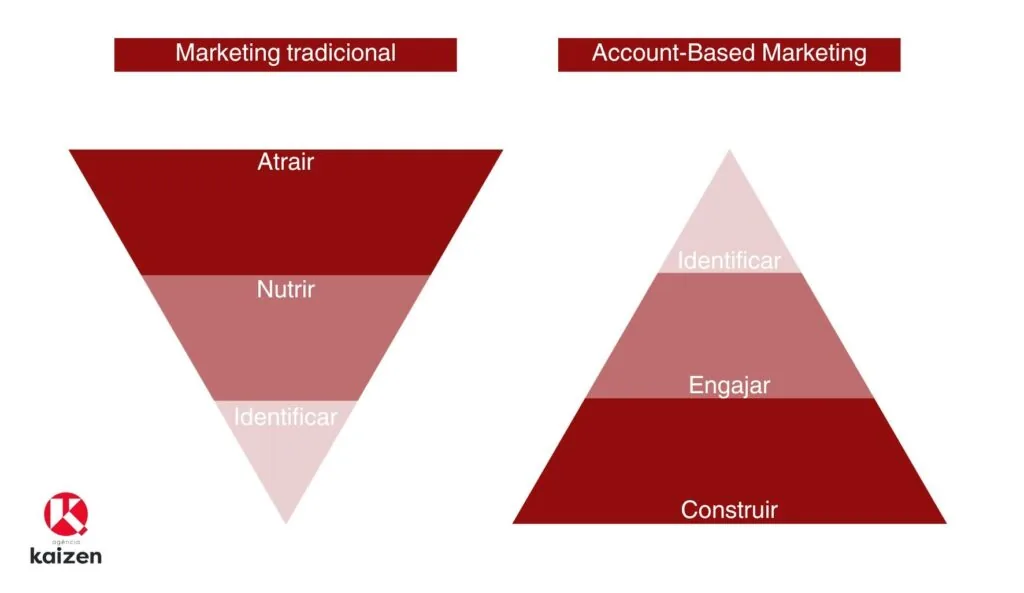
What is the difference between Account-Based Marketing and Inbound Marketing?
Inbound Marketing and Account-Based Marketing are two distinct approaches to digital marketing. Each has its own strategies and goals. While Inbound Marketing focuses on attracting a broad audience and then nurturing leads over time, ABM targets a highly specific audience from the start.
In Inbound Marketing, the content aims to attract visitors and convert them into leads, while ABM directly seeks ideal accounts. However, these two strategies are not mutually exclusive. In practice, companies choose to combine ABM with Inbound Marketing to address different segments of their target market more comprehensively.
Who is Account-Based Marketing for?
Account-Based Marketing is ideal for companies that have a well-defined target audience and want to direct their marketing efforts precisely and effectively. This is especially relevant for B2B (business-to-business) companies that have a longer sales cycle and involve multiple stakeholders in complex purchasing decisions.
As it is a highly customizable strategy, ABM should ideally involve the efforts of both marketing and sales teams. After all, the main goal is to work on attracting, converting, and retaining customers. Since we are talking about personalized campaigns aimed at ultimately retaining the audience, it is ideal that they focus on quality rather than quantity. In other words, strategies that aim to reach the right audience are more efficient when the goal is to retain customers. Thus, the match is much more effective.
For this reason, ABM is also geared towards businesses that make complex, high-ticket sales. In this case, the strategies directly involve the decision-makers of these companies. For this reason, it is possible to offset the costs involved in developing an ABM campaign.
In summary, ABM is intended for:
- Companies that want to focus on strategically important accounts.
- B2B companies that have a well-defined target audience.
- Companies with resources to create highly personalized marketing strategies.
What are the types of Account-Based Marketing?
Account-Based Marketing strategies are divided into three modalities. Generally, each is intended for specific needs and resources. Learn more about them below.
Programmatic ABM (1:many)
First, there is programmatic ABM, which is the broadest approach. In this, marketing strategies target a large number of companies that share similar characteristics. Therefore, the personalization efforts are smaller compared to other forms of ABM, but segmentation is still precise.
In practice, the strategy is aimed at a broad base of ideal accounts that can benefit from the company's products or services.
ABM Lite (1:few)
As the name suggests, ABM Lite is an intermediate version between programmatic and strategic ABM. In this approach, the focus is on a smaller group of companies that are highly relevant to the business. This strategy allows for deeper and more targeted personalization.
ABM Lite is ideal for companies with limited resources that want to reach specific accounts in a more personalized way.
Strategic ABM (1:1)
Finally, strategic ABM is the most personalized and targeted form of Account-Based Marketing. Here, the company concentrates efforts on a single account or a small group of strategic accounts for the business.
This approach is the most resource-intensive but also offers the highest returns. Therefore, it is often extremely advantageous in cases of complex or high-value sales.
However, it is important to know that, regardless of the type of ABM, the key to success is personalization. The more the company adapts to the needs and challenges of its target accounts, the greater the likelihood of success.
5 advantages of Account-Based Marketing
1. Increased conversion rate
One of the main advantages of ABM is the improvement in the conversion rate. By focusing on qualified accounts, campaigns are more likely to result in actual conversions. In practice, this saves time and resources as efforts are directed towards the most promising prospects.
2. Greater customer retention
ABM is not just about acquiring new customers, but also about maintaining and expanding relationships with existing customers. In this case, the continuous personalization of content for existing customers contributes to retention and more effective cross-selling.
3. Alignment between marketing and sales
ABM promotes close collaboration between marketing and sales teams. This is crucial for success, as both work together to identify, reach, and convert ideal accounts.
4. Clearer and measurable metrics
ABM provides clearer and measurable metrics, as the company directs its efforts towards specific accounts. This makes it easier to assess the impact of campaigns and determine ROI accurately and efficiently.
5. Personalization and relevance
We know that personalization is the essence of ABM, right? Therefore, creating personalized content shows prospects that the company is genuinely interested in meeting their needs. This creates a deeper connection and increases the likelihood of success.
Stages of Account-Based Marketing
Now that you have a greater understanding of this strategy, it is time to understand the main stages of Account-Based Marketing. They aim to shorten the company's path to ideal accounts, prioritizing efficiency in the journey.
1. Identify and define target accounts
The first step in ABM is to identify and define the accounts that are essential for the business. This involves collaboration between marketing and sales teams to determine which companies fit the ICP, or Ideal Customer Profile, which defines the ideal customer profile. We can say that having this definition is an essential step for the success of ABM.
2. Create a list of accounts with their decision-makers
With the identification of target accounts, it is time to create a list with detailed information. The marketing and sales teams should identify the decision-makers in each account, that is, those who have influence over purchasing decisions. As you can see, we are talking about crucial information for the effective direction of the strategy.
3. Create offers and produce personalized content
As mentioned earlier, the heart of ABM lies in personalization. Therefore, it is essential to create highly personalized offers and content. After all, they must resonate with the specific needs and challenges of each account.
To surprise the audience, among the content tips are exclusive materials such as eBooks, case studies, webinars, or other resources that add value to the target company.
4. Develop a campaign
With all the previous steps completed, it is time to put the strategy into practice. That is, based on the defined list of accounts and with the personalized content ready, it is time to develop the campaigns.
An Account-Based Marketing campaign may include sending personalized emails or direct contact. However, it can also be valuable to run ads on platforms like LinkedIn, which has a B2B profile.
5. Measure the results
Finally, measurement is a fundamental part of ABM. With campaigns running, it is time to closely monitor the results. It is possible, for example, to check engagement, awareness, and impact on conventional marketing metrics. By analyzing all available data, the process of refining and improving the strategy becomes more efficient.
How to put ABM into practice?
- Collaboration between marketing and sales: a close partnership between marketing and sales teams is essential in the ABM method.
- Automation tools: use marketing automation tools to personalize and scale your campaigns.
- Training and education: train the team and ensure they truly understand the ABM methodology.
- Constant analysis: analyzing metrics is important to adjust the strategy based on data and results.

How to create content for Account-Based Marketing
The personalization of content is so relevant for ABM that we will mention it once again here. Therefore, it is important to invest in creating quality content that is relevant to the target company.
Those who work in this market know well that securing the desired meeting with the prospect is not an easy task. Often, a long period of relationship is necessary for it to actually happen. Therefore, evaluate the following tips to produce personalized content and work your audience efficiently in ABM.
Extreme personalization
No surprises here; after all, content creation must be extremely qualified. Invest in relevant and personalized materials that resonate with the needs and challenges of each target account.
Multiple channels
Forget about focusing on just one channel. The prospect needs to be reached through different means so that the brand becomes present in their routine. Therefore, the tip is to use channels such as email, social media, and ads to reach accounts comprehensively.
If you think emails no longer work, it's worth checking the data below:
- 92% of executives pay attention to unsolicited emails, even if sent by a company they have never done business with.
- 1 in 4 executives will read unsolicited emails that contain ideas that may be relevant to their business.
- 78% of decision-makers scheduled appointments or attended an event as a result of a cold email.
Monitor engagement
Regularly monitoring campaign results is essential. Therefore, it is important to pay attention to engagement data from target accounts and adjust tactics based on these insights.
How to measure results in Account-Based Marketing
But, after all, how to measure results in ABM? Throughout this article, we have mentioned numerous times the relevance of data analysis for the success of campaigns. In this particular universe of Account-Based Marketing, there are extremely relevant metrics that provide an overview of the strategies.
Reach: How many accounts did you reach with your campaigns?
Awareness: What is the level of brand recognition among target accounts?
Engagement: How are accounts interacting with your content and campaigns?
Alignment of marketing actions: How aligned are your marketing actions with the needs of target accounts?
Impact on conventional metrics: How does ABM affect traditional marketing metrics such as conversions and revenue?
Why do Account-Based Marketing?
Generation of highly qualified leads
The first reason to do ABM is to ensure access to more relevant accounts. Additionally, the strategy provides that campaigns are personalized to attract high-quality leads.
Better collaboration between marketing and sales
Moreover, ABM promotes close collaboration between marketing and sales teams. After all, we have seen that it is essential for both teams to work in harmony to ensure the success of campaigns. Therefore, it is important that all professionals are aligned regarding goals and strategies.
Higher Return on Investment (ROI)
It may seem obvious, but it is relevant to mention: by directing resources to ideal accounts, the probability of conversion increases, and consequently, ROI improves. Thus, we can say that the investment in ABM is smart and effective.
Building lasting relationships
Furthermore, Account-Based Marketing focuses on customer retention. In other words, it helps build long-term relationships with target customers, resulting in more enduring and valuable business.
Personalization
The ABM strategy revolves around personalization, which represents highly relevant and effective campaigns.

Account-Based Marketing is essential for successful strategies
Account-Based Marketing is a powerful approach for companies that want to direct their marketing efforts towards ideal accounts. With its strategies, it is possible to generate qualified leads and build lasting relationships, focusing on retention.
But, be careful: remember that ABM is not a one-size-fits-all approach for all companies. Being customizable, it can adapt to meet the specific needs of each business. Regardless of the type of ABM, creating strategic content and paying attention to ideal accounts are the keys to success.
Do you want to generate qualified leads and increase sales?
If you want to boost your marketing and sales strategies, implementing Account-Based Marketing may be interesting. The way to implementation is to partner with a digital marketing agency focused on results, like Kaizen.
Contact us and find out how we can contribute to generating qualified leads for your business.