
Introduction
If you have a business, you have probably heard of CRM. But after all, what is CRM? CRM stands for Customer Relationship Management. But the concept goes far beyond the acronym.
A CRM system is a platform that centralizes all information about your customers and leads in one place: interaction history, contact data, ongoing negotiations, purchase preferences, and much more. In 2026, CRM has ceased to be a "bonus" and has become the operational heart of any business that takes sales seriously.
Why does your company need a CRM?
1. 360° view of the customer
Without CRM, your customer information is scattered across spreadsheets, emails, WhatsApp, and in the heads of salespeople. With a CRM, you have a complete view of each customer: when the last contact was, what they purchased, what they asked, and what objections they had.
2. Increased team productivity
Salespeople waste 30% of their time on administrative tasks. A CRM automates reminders, records interactions automatically, and eliminates rework. Your team sells more and spends less time on bureaucracy.
3. Revenue predictability
With organized historical data, you can predict how much you will sell next month, identify bottlenecks in the funnel, and act before losing opportunities.
4. Customer retention
Well-served customers return. CRM allows you to track post-sale, schedule periodic contacts, and prevent old customers from falling into oblivion.
Types of CRM: which one to choose?
Operational CRM
Focused on day-to-day operations: lead management, task automation, sales pipeline, integration with communication channels (WhatsApp, email, chat). It is the most common and what most companies need.
Analytical CRM
Focused on data: reports, dashboards, customer behavior analysis, trend forecasting. Ideal for companies that already have a volume of data and want to extract insights.
Collaborative CRM
Focused on communication between teams: information sharing, service center, integration between sales, marketing, and support.
Essential features of a modern CRM
In 2026, a reputable CRM must have:
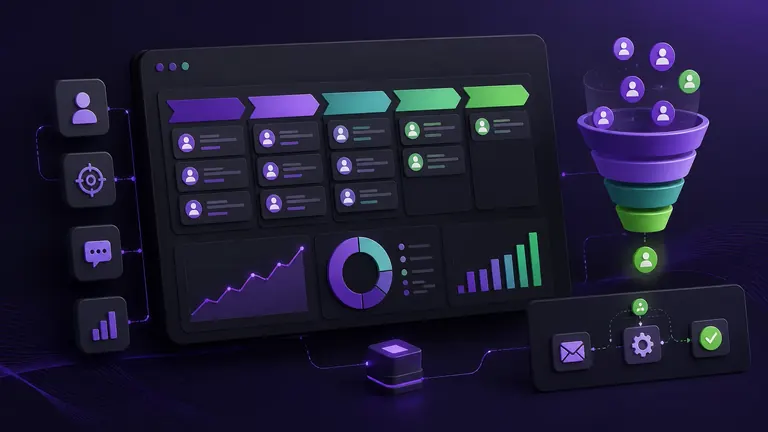
- Visual sales pipeline — drag leads between funnel stages
- WhatsApp integration — conversations automatically recorded in the CRM
- Task automation — reminders, automatic follow-ups, email dispatch
- Reports and dashboards — real-time data on performance
- Lead management — capture, qualification, and automatic distribution
- Mobile app — access from anywhere
- API for integrations — connect with other tools
CRM for small businesses vs. large businesses
Small businesses
Need a simple, inexpensive, and easy-to-implement CRM. The focus is on organizing leads and not losing opportunities. Solutions like Zoho CRM, Kommo, and PipeDrive are ideal.
Large businesses
Need customization, multiple pipelines, complex automations, and integration with ERPs. Here, solutions like Salesforce, HubSpot Enterprise, and Zoho CRM Plus come into play.
How to implement a CRM in your company
- Map your sales process — understand how your leads enter, are qualified, and converted
- Define the funnel stages — from the first contact to closing
- Choose the right tool — evaluate features, price, and support
- Configure integrations — WhatsApp, email, website forms
- Train the team — the tool is useless if no one uses it
- Monitor and adjust — analyze reports and optimize the process
Frequently asked questions about CRM
What is the difference between CRM and ERP?
ERP manages internal resources (inventory, finance, HR). CRM manages customer relationships. Many companies use both integrated.
Is CRM only for sales?
No. Although it is more commonly used by sales, CRM also serves marketing (campaign management) and support (customer service).
Do I need a CRM if my company is small?
Yes, even more so. Small businesses need to organize each lead — a CRM prevents opportunities from being lost in the hustle and bustle of daily life.
What is the best free CRM?
Zoho CRM has a robust free plan (up to 3 users), and HubSpot also offers a free version with basic features.
Want to know which CRM is ideal for your company? Kaizen is a partner of Zoho CRM and Kommo — we can help you choose and implement the right solution.