
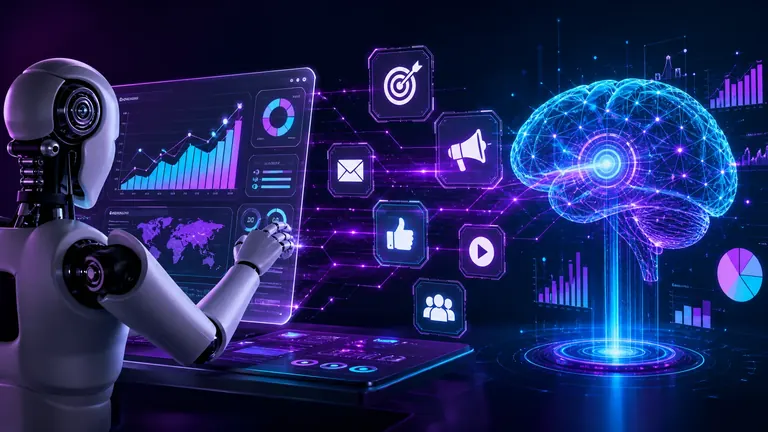
Artificial intelligence refers to systems or machines that imitate human intelligence to perform tasks and can iteratively improve based on the information they collect. In digital marketing, AI is being used to personalize user experiences, segment audiences, and optimize campaigns.
Digital marketing, in turn, encompasses all activities that use the internet and electronic devices to promote products and services. The convergence between AI and digital marketing is creating new opportunities for companies of all sizes, allowing them to reach their audiences more effectively and efficiently.
With AI, digital marketing strategies can be automated, improving accuracy and reducing operational costs. This fusion is enabling deeper analysis of consumer behaviors, optimizing investments, and personalizing interactions in unprecedented ways.
What is Artificial Intelligence?
Artificial Intelligence is a field of computer science focused on creating systems that can perform tasks that typically require human intelligence. This includes speech recognition, decision-making, and language translation.
AI systems use advanced algorithms to process large volumes of data, learning and adapting over time. This continuous learning capability is what makes AI so powerful in transforming sectors like digital marketing.
With the exponential increase in available data, AI has become an essential tool for companies looking to better understand their customers and optimize their marketing strategies.
Overview of Digital Marketing
Digital marketing encompasses all promotional activities that use the internet and digital platforms as the primary means of communication. It includes SEO, content marketing, social media, email marketing, among others.
With global digitization, digital marketing has become a priority for companies seeking to reach their target audiences effectively and measure results in real-time. The use of AI enhances these activities by automating processes and analyzing data more swiftly.
Companies that can integrate AI into their digital marketing strategies tend to gain a significant competitive advantage, improving the efficiency and personalization of their campaigns.
Convergence Between AI and Marketing
The convergence between AI and digital marketing is creating a landscape where operations are increasingly driven by data. AI enables the collection and analysis of large volumes of information, resulting in more targeted and effective campaigns.
This integration is being seen in areas like campaign automation, where AI can schedule and execute marketing actions based on consumer behaviors, saving time and resources for companies.
Moreover, AI allows for unprecedented personalization, adapting content and offers for each individual user, which increases relevance and engagement with the brand.
Main Applications of AI in Digital Marketing
The applications of artificial intelligence in digital marketing are vast and constantly evolving. They range from campaign automation to content personalization and data analysis for market predictions.
These innovations are enabling companies to operate more agilely and efficiently, responding quickly to changes in consumer behavior and market trends. Below, we will explore some of the most impactful applications of AI in the sector.
Campaign Automation
Campaign automation is one of the most common applications of AI in digital marketing. With the ability to process and analyze data in real-time, AI can schedule and execute marketing campaigns automatically.
This not only saves time but also increases the accuracy of campaigns, allowing for instant adjustments based on consumer behavior. Automation is crucial for managing multiple campaigns across various platforms simultaneously.
Companies that adopt AI campaign automation can experience a significant increase in efficiency and ROI (return on investment) from their marketing strategies.
Content Personalization
Content personalization is an area where AI truly shines. By using user behavior data, AI can create personalized experiences for each visitor, increasing relevance and engagement.
This includes product recommendations, dynamic content on websites, and personalized emails. Personalization not only enhances the customer experience but can also increase conversion and retention rates.
By offering personalized content, companies can build stronger relationships with their customers, fostering greater brand loyalty.
Data Analysis and Predictions
Data analysis is fundamental to the success of any digital marketing strategy. AI can quickly process large volumes of data, identifying patterns and trends that can inform marketing decisions.
With the ability to predict future consumer behaviors, companies can proactively adjust their marketing strategies rather than reactively. This results in more effective and efficient campaigns.
Additionally, AI-based data analysis can help identify new market opportunities and optimize resource allocation, ensuring that marketing investments are well-directed.
Benefits of AI for Marketing Strategies
Increased Operational Efficiency
With AI, companies can automate repetitive and time-consuming tasks, freeing up human resources to focus on more strategic activities. This increases the overall efficiency of marketing operations.
For example, automating advertising campaigns and lead management with AI can significantly reduce the time spent on manual tasks, allowing for a quicker response to market changes.
Moreover, by eliminating human error in automated processes, companies can improve the accuracy and quality of their marketing operations.
Improved Customer Experience
AI allows for deeper personalization of customer interactions, resulting in a significantly improved user experience. By delivering personalized content and offers, companies can increase customer satisfaction and loyalty.
AI tools, such as chatbots, enable quick and efficient interactions, helping to resolve customer issues in real-time and enhancing the overall experience with the brand.
Understanding and anticipating customer needs through data analysis allows companies to offer a more personalized and enjoyable shopping experience.
Optimization of Advertising Investments
AI helps companies optimize their advertising investments by identifying the most effective strategies and adjusting campaigns in real-time to maximize return on investment (ROI).
With the ability to analyze ad performance data, AI can recommend adjustments to improve the reach and effectiveness of campaigns, ensuring that advertising resources are allocated as efficiently as possible.
This not only improves ROI but also allows companies to be more agile and adaptable in their advertising strategies.
Challenges and Ethical Considerations
Despite the many benefits, the integration of AI in digital marketing also presents significant challenges and ethical considerations. Issues of privacy, data security, and transparency are major concerns that companies need to address.
Privacy and Data Security
The use of AI in digital marketing raises concerns about consumer data privacy and security. Companies need to ensure that they are collecting and storing data responsibly and in compliance with data protection regulations.
Implementing robust security measures is essential to protect customers' personal data and avoid security breaches that could harm the company's reputation.
Additionally, it is important for companies to be transparent about how consumer data is being used to build trust and brand loyalty.
Transparency and Trust
Transparency is crucial when it comes to AI in digital marketing. Consumers have the right to know how their information is used, and companies need to be clear about this.
Building trust with consumers through transparent practices will help ensure that customers feel comfortable sharing their data and continue to engage with the brand.
Companies should clearly communicate their privacy policies and data usage to maintain customer trust and loyalty.
Ethical Implications of Automation
AI-driven automation in digital marketing raises ethical questions about the impact on employment and fair marketing practices. It is important for companies to consider the ethical implications of their automation strategies.
Promoting responsible automation includes ensuring that marketing practices are fair and that automation does not result in discrimination or misleading practices.
Companies must balance the efficiency of automation with the need to maintain ethical and responsible practices.
Essential AI Tools for Marketing
Marketing Automation Platforms
Marketing automation platforms, such as HubSpot and Marketo, use AI to automate and optimize marketing campaigns. They allow companies to manage multiple campaigns across different channels efficiently.
These platforms help segment audiences, personalize messages, and analyze campaign performance in real-time, resulting in more effective marketing strategies.
Marketing automation not only saves time but also improves the accuracy and effectiveness of campaigns.
Data Analysis Solutions
Data analysis solutions, such as Google Analytics and Tableau, utilize AI to process large volumes of data and provide valuable insights into consumer behavior.
These tools allow companies to identify trends, adjust their marketing strategies, and improve customer engagement.
AI-based data analysis is crucial for informed decision-making and optimizing marketing campaigns.
Virtual Assistants and Chatbots
Virtual assistants and chatbots are AI tools that enhance customer interaction by providing immediate support and quick responses to common questions.
These systems can be integrated into websites and communication platforms, improving the user experience and reducing the workload of customer service teams.
In addition to providing support, chatbots can collect data from customer interactions, providing valuable information for future personalization.
Future Trends of AI in Digital Marketing
Adoption of AI in Small Businesses
Small businesses are beginning to adopt AI to compete with larger market players. The increasing accessibility of AI tools is allowing smaller businesses to optimize their marketing operations without significant investments.
With AI, small businesses can personalize their offerings and improve customer experience, increasing their competitiveness in the market.
This trend is democratizing digital marketing, enabling companies of all sizes to leverage the advantages of AI.
Evolution of User Interfaces
The evolution of user interfaces is being driven by AI, with more intuitive and interactive interfaces being developed. This improves the user experience and increases engagement with brands.
Voice-based interfaces and augmented reality are some of the innovations being explored, offering new ways to interact with consumers.
These enhanced interfaces promise to transform how companies communicate with their customers, making interactions more natural and engaging.
Innovations in Programmatic Advertising
Programmatic advertising is benefiting from AI, with innovations that allow for the automated buying and selling of advertising space in real-time. This increases the efficiency and effectiveness of advertising campaigns.
With AI algorithms, programmatic advertising can target audiences more precisely, ensuring that ads are shown to the right people at the right time.
These innovations are revolutionizing how advertising is bought and sold, providing better results for companies.
The Role of Marketing Agencies in the AI Era
Importance of Having a Proprietary CRM
Having a proprietary CRM is essential for marketing agencies that utilize AI. A CRM helps manage customer relationships and securely store data, allowing for more effective personalization.
With a CRM, agencies can collect and analyze customer data more quickly, improving the accuracy and effectiveness of marketing campaigns.
This results in a better customer experience and greater satisfaction with the agency's services.
Continuous Training and Updates
To remain competitive, marketing agencies need to invest in continuous training and updates for their teams. This includes training in new AI technologies and digital marketing practices.
Training ensures that teams are prepared to implement and manage effective AI solutions, keeping marketing campaigns innovative and competitive.
Agencies that invest in ongoing training are better positioned to take advantage of the opportunities offered by AI.
Strategic Partnerships and Collaborations
Strategic partnerships and collaborations are essential for marketing agencies looking to integrate AI into their operations. Collaborating with technology companies can accelerate the adoption of AI solutions.
These partnerships allow agencies to access additional expertise and resources, ensuring that AI implementations are successful and that campaigns are innovative.
Moreover, collaborations can help agencies expand their service offerings and reach new markets.
Case Study: How Agência Kaizen Stands Out
Agência Kaizen is a success story in the use of AI in digital marketing. With innovative strategies, the agency has distinguished itself in the market and achieved impressive results for its clients.
Innovative Strategies Used
Agência Kaizen utilizes a combination of marketing automation and content personalization to create highly effective campaigns. The agency invests in cutting-edge technology to ensure that its strategies are always innovative.
These strategies allow Kaizen to offer personalized solutions for its clients, increasing engagement and customer satisfaction.
Constant innovation is one of the pillars of Kaizen's success in the competitive digital marketing landscape.
Impact of Being a Google Premier Partner
Being a Google Premier Partner has brought numerous benefits to Agência Kaizen. This includes access to exclusive resources and specialized support, allowing for more effective optimization of Google Ads campaigns.
As a Google Premier Partner, Kaizen has the ability to offer valuable insights and advanced strategies for its clients, increasing the reach and effectiveness of campaigns.
This partnership strengthens Kaizen's position as a leader in the use of AI for digital marketing.
Results and Client Testimonials
Agência Kaizen has a proven track record of positive results for its clients. Testimonials highlight increased ROI and improved customer experience as key benefits of partnering with Kaizen.
Clients praise the agency's innovative and personalized approach, which translates into successful and satisfying marketing campaigns.
Client satisfaction is a priority for Kaizen, and this is reflected in the results the agency consistently achieves.
Conclusion
In summary, what are the applications of artificial intelligence in digital marketing? The answer encompasses automation, personalization, and data analysis, among others. The benefits are clear: increased efficiency, improved customer experience, and optimized investments.
However, there are also challenges and ethical considerations, such as privacy and transparency, that need to be carefully managed. As AI continues to evolve, it is expected to play an even more significant role in digital marketing.
To remain competitive, companies should explore the available AI tools and strategies, ensuring that their marketing operations are both innovative and responsible. We encourage you to continue exploring these technologies to maximize the results of your campaigns.
Frequently Asked Questions
How is artificial intelligence being used in digital marketing?
Artificial intelligence is used for campaign automation, content personalization, data analysis, and trend forecasting, making digital marketing strategies more effective and efficient.
What are the main benefits of AI for marketing campaigns?
The main benefits include increased operational efficiency, improved customer experience, and optimized advertising investments, resulting in higher ROI.
Are there risks associated with using AI in digital marketing?
Yes, there are risks such as concerns about privacy and data security, as well as ethical considerations regarding automation and transparency in marketing practices.
What AI tools are most recommended for marketing professionals?
Recommended tools include marketing automation platforms like HubSpot, data analysis solutions like Google Analytics, and virtual assistants like chatbots.
How are digital marketing agencies adapting to the era of AI?
Agencies are adopting proprietary CRMs, investing in continuous training, and forming strategic partnerships to effectively integrate AI into their operations.
What does it mean to be a Google Premier Partner in the context of AI?
Being a Google Premier Partner provides access to exclusive resources and specialized support, allowing for the optimization of Google Ads campaigns and better marketing results.
What are the emerging trends in AI for digital marketing?
Trends include the adoption of AI by small businesses, the evolution of user interfaces, and innovations in programmatic advertising, all promising to transform the sector.