

Learn all about the competitor to the well-known Chat GPT and Bing
The first four months of 2023 have been eventful, at least regarding technology and artificial intelligence. After the boom of Chat GPT (which we have already discussed on our blog, just click here to check it out), now it's time to get to know Bard, Google's AI that will soon be launched.
In testing phase, Bard currently works only in English (in the UK and the US) and is not available in Brazil. However, Google claims that the tool will be available to all users later this year. Oh, the feature, which will initially be free, is expected to be integrated into Google's search engine and other company services. Could a strong competitor to the new Bing be on the way?
How does Bard work?
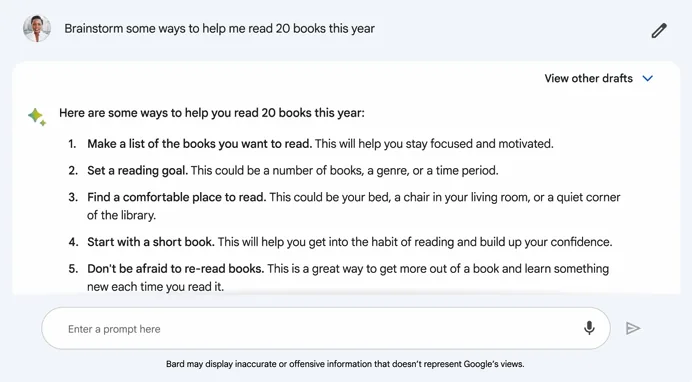
Those who have tested Bard noted that the tool operates very similarly to Chat GPT. From its interface, which is clean and presents only the essentials on the screen. For example, when opening the page, the user finds a sidebar menu with buttons for management, history, and support. It is even possible to request that the platform does not store your usage data.
All of Google's robot settings are already available in Brazilian Portuguese, which is a good sign. In other words, very soon the tool will indeed be available in our country. Additionally, the user interface features a central area where prompts can be entered, similar to that found in Chat GPT that we already know.
Bard is an experimental conversational AI service, powered by LaMDA. Built using our large language models and drawing on information from the web, it’s a launchpad for curiosity and can help simplify complex topics → https://t.co/fSp531xKy3 pic.twitter.com/JecHXVmt8l
— Google (@Google) February 6, 2023
But of course, there are differences between the artificial intelligence tools. One of them is that Bard delivers the complete answer at once, unlike its main competitor, which reveals the text as it formulates the response. Another novelty of Google's robot compared to the OpenAI robot is the display of drafts for each prompt. This way, the user can choose the approach and formatting that best meets their needs.
Google it! Finally, Bard's answers come with a search button. In other words, it's the ease of "Googling" and understanding each topic better.
What language is used?
Bard is a generative artificial intelligence technology developed internally by Google and based on LaMDA (Language Model for Dialogue Applications). In short, it is a language model tool for dialogue applications. Like Chat GPT 3.5, Bard operates through a training process, where it seeks text samples and converts them into personalized responses.
Current AI landscape
As we can see, AI is changing the way we interact with technology. In addition to virtual assistants like Siri and Alexa, mechanisms like Bard, Chat GPT, and Bing are transforming how we use technology in our daily lives.
Microsoft's Bing search tool uses artificial intelligence to improve the accuracy of results. On the other hand, Chat GPT, developed by OpenAI, is a natural language processing technology that allows users to interact with a conversational robot in a way similar to human conversation. Meanwhile, Bard, which is still in the testing phase, is a creation of Google and promises to combine functionalities from the two previous technologies and provide a complete user experience.
However, there are still challenges in the evolution of artificial intelligence, such as the need for greater accuracy and the ability to interpret the nuances of natural language. This is one of the main aspects that users need to observe when using the resources. Despite these challenges, AI continues to develop rapidly, with many companies and organizations adopting it to enhance user experience and create personalized solutions that meet their clients' needs.

Be aware of the obstacles in using artificial intelligence robots
Although these artificial intelligence robots can be helpful in content creation, they still present obstacles and flaws. One of the main problems is that, even with advanced machine learning, they still cannot match human understanding and empathy. This means that the responses generated by the robot can be misinterpreted or insensitive, especially regarding cultural nuances or tones that one wishes to convey in the text.
Moreover, since AI robots are programmed to respond based on patterns found in large datasets, they may reproduce false, erroneous, or even outdated information. After all, the system is based on data collected prior to its use. For example, did you know that Chat GPT bases its responses on data collected until the end of 2021? For this reason, much of the information provided by the tool may be outdated.
In a quick test to prove this, we asked Chat GPT which team won the 2022 World Cup. And the response we received was as follows: I am an artificial intelligence trained until 2021, so I do not have information about events that will occur in the future, such as the result of the 2022 World Cup. However, you can follow the news about the competition and find out who the winner will be as soon as the World Cup takes place. Sorry for not being able to provide the precise answer you are looking for.
The interesting thing is to stay tuned to the news that emerges and, with discernment and common sense, know how to apply them in daily life. Here on the Kaizen blog, you can stay updated on everything happening in the world of technology applied to digital marketing.