

Why is having a blog important? Discover in this special content!
If you have a company, regardless of the industry, you know that having a website is essential. After all, the internet has become the primary place to search for new services and products. Therefore, those who are not online are not seen and, even less, remembered.
Digital marketing in numbers
Did you know that 68% of Brazilians search the internet even before buying in a physical store? The figure obtained by Connected Life aligns with the alarming percentage of companies that are still taking their first steps in digital marketing. According to a survey by McKinsey in partnership with the Brazilian Advertisers Association (Aba), 80% of Brazilian companies are crawling in the digital space.

What is a blog?
A blog is an authorial content channel used to connect with the audience. It is through it that a company can improve its ranking in search engines and increase organic traffic. In other words, having a website is not enough. The site needs to be constantly updated, and that’s why a blog is necessary.
But before we explore the reasons why your company needs a blog, let’s understand what this section within a website is? To discuss this, we need to go back a few decades…
It all started in 1983, with the emergence of a discussion group with functions similar to a blog. In 1994, three years after the term “World Wide Web” or simply “www” was launched, the concept of a blog was born. In 1997, with the consolidation of the so-called “weblog,” people began to use this digital space to share their routines, tutorials, and other relevant topics for specific audiences.
The blog today
If in the past blogs functioned as virtual diaries where authors shared details of their routines, today we see a new format. After all, this function is now taken over by social media. It is there that users share everything from the moment they wake up until they go to sleep. Thus, the role of the blog has changed. Now it has much more to do with performance and results.
Nowadays, the blog is intended for the production of authorial content, with explanatory texts on different subjects. Everything will depend on the audience you want to reach. For companies, the blog has become an efficient mechanism to deliver valuable content to potential customers. It is the gateway to a closer and more solid relationship. We can even say that the blog helps the company sell more.
In other words, this section is fundamental within a website. It is an irreplaceable communication resource when the goal is to improve ranking and increase organic traffic.

5 Reasons to Have a Blog
1. Educate the audience
By sharing relevant content on topics of interest to potential customers, you can highlight the relevance of your product or service. This way, blog visitors have access to rich and quality materials about the company’s industry. In fact, the texts should explore the main pain points that the product in question can solve.
2. Establish authority
Having a blog on the institutional website helps the company to establish itself as an authority in its field. However, it is necessary to develop authorial texts with clarifying content. This way, the company has the opportunity to showcase its experience to the audience, creating authority for the business online.
3. Rank on Google
As mentioned above, a blog can improve the site's organic traffic thanks to its ranking on Google. This happens because many of the evaluation criteria used to rank pages are related to the site's content. Therefore, it is worth paying attention to the texts to improve the site's indexing in Google results.
Remember that algorithms use certain criteria for this, such as keywords, text structure (H1, H2, images, paragraph length), internal and external links, as well as text scannability. All of this will be discussed next.
4. Stimulate sales
Companies that want to sell more have blogs as an important tool. After all, by educating the audience, establishing authority in the field, and ranking on Google while increasing organic traffic, it is also possible to improve performance with the ideal customer. All of this can be enhanced with a good inbound marketing strategy, attracting the audience to the blog. Remember to use forms, contact buttons, and CTAs to maximize lead capture.
5. Sustainable and permanent results
Thinking of the blog as an ally for online performance is essential for it to continue generating results. In this sense, it is important to know that the blog is a digital marketing tool with medium and long-term results.
It needs to be updated periodically so that it continues to bring good results in the future. This happens because all published content remains online, unlike traditional media, which have an “expiration date.” Therefore, relevant content on a given topic will continue to be seen even years after its publication.

SEO for Blogs
SEO (Search Engine Optimization) techniques are used to bring the blog to the top positions on Google. Daily, thousands of people use the search engine to research various topics. Thus, the better positioned the site is, the greater the chances that users will click. In other words, SEO for blogs is an important tool for digital marketing, increasing organic traffic.
Understand better…
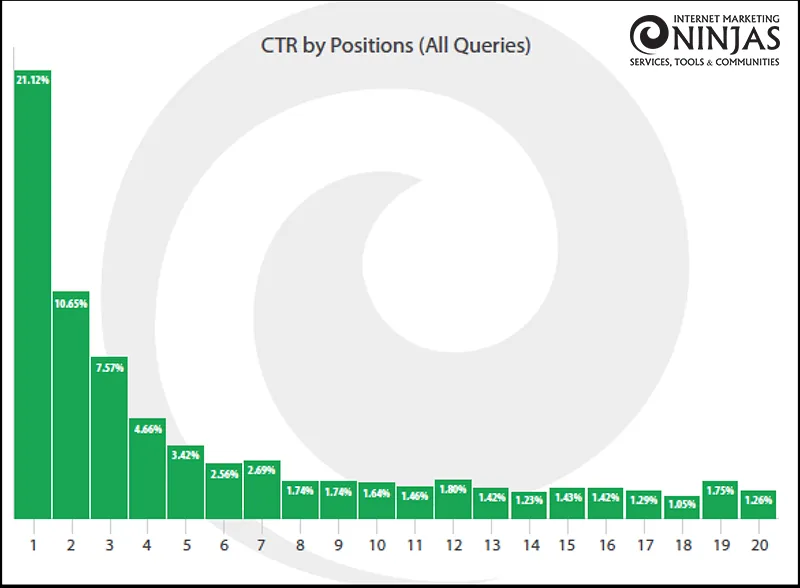
After analyzing 20,000 Google queries over a three-month period, the company Internet Marketing Ninjas found that the first result displayed on the Google results page receives approximately 21% of clicks. The second and third sites receive 10% and 7%, respectively. In other words, almost half of user clicks occur among the top results displayed.
This means that it is essential to be on the first pages of Google to increase the number of visits to a site. And SEO is used precisely for that: to optimize sites and their content. Thus, they become increasingly accepted by search engines like Google, Yahoo!, and Bing. For a site to be displayed in the top positions on Google, the algorithm reads certain information. These are formulas that help improve a site's ranking, aiming to bring it to the top of the results.
How to optimize texts with SEO?
A text written according to SEO principles needs to consider several points. In general, all of them meet Google's own requirements, focusing on site indexing and better positioning on the search engine results pages (SERP).
SEO content consists of well-written articles, considering everything from grammatical and spelling rules to SEO principles. Thus, an optimized text goes far beyond content quality. There are basic elements that help improve results and achieve good positions.
To understand better, we can say that Google's algorithm – which is based on over 200 variables – considers the quality of the text as well as its compliance with SEO criteria. But after all, what are these criteria?
1. Keyword selection
The selection of the keyword is the first step to optimizing content for SEO. It is what helps in the site's positioning. The keyword should be chosen even before starting the text production, as it will guide the entire writing process and influence other criteria we will see next.
To define the keyword, pay attention to the company's industry and the type of content you want to rank on Google. After all, there’s no point in writing a wonderful text if the search rate for the keyword is low. Therefore, it is ideal to evaluate the following criteria to choose the ideal keyword: search volume, ranking difficulty, sales funnel stage, and site positioning for the keyword.
2. Tag optimization
Websites and their internal pages have important HTML tags for SEO text. And the choice of the keyword is closely related to tag optimization. Among them is the Meta Title Tag, which is one of the main elements of SEO-optimized content.
The Title Tag, or text title, is one of the most important aspects analyzed by search pages. After all, it appears in the browser tab as soon as the blog page is opened. Therefore, the keyword needs to be present in this tag, preferably at the beginning of the title. Also, pay attention to the size of the Title Tag, as there is a character limit to be respected.
In addition to the Title Tag, there is also the Meta Description Tag (HTML Meta Tag), which is the description of the article's content, and the Heading Tags, which are the famous “H1, H2, H3…” of the text. Or, in other words, the title and its subtitles. The keyword should be used in the Heading Tags whenever it refers to an important title or subtitle.
And, attention! It is recommended to place it in the H1, okay?
3. Keyword density
Is it important to repeat the keyword throughout the text? If so, how many times is ideal? This is a common doubt among content producers, but the answer can vary from text to text. In general, it is suggested that the keyword appears between 1% and 3% of the text volume, but this is not a fixed rule. In addition to using it obligatorily in the title and in some Heading Tags, repeat the keyword throughout the text, always prioritizing a natural writing style. Excesses should be avoided!
4. Use of internal and external links
Linking considers both internal and external links. The former are related to the time a visitor spends on the site, aiming to reduce the Bounce Rate. Internal links pointing to other blog articles or site tabs help users navigate between different sections.
External links are even more relevant and are also monitored by Google. This practice can generate more authority for the site's domain. This helps improve positioning in search results. Ideally, there should be at least one external link in the blog article.
5. Use of media (images and videos)
In addition to quality text, it is very important for a blog article to have images related to the content. This improves text readability and helps retain users. By inserting images, it is possible to reduce bounce rates, working towards better positioning on search pages. Videos are also accepted and can make the content more dynamic and engaging.
An important detail is to configure the image with information such as alt text (alternative text) and caption, remembering to include the keyword in the first item.
6. Text size and structure
Just like in a school essay or entrance exam, the structure of the text makes all the difference in blog content. Good SEO practices do not define an exact size, but according to a study by Backlinko in 2020, texts present in the top 10 positions on Google have an average of 1500 words.
The blog text can be divided into introduction, summary, and paragraphs. In the introduction, remember to insert the keyword, as Google's algorithm monitors its presence in the first paragraph. The summary can be inserted next, with the order of the upcoming subtitles, preferably with bullet points. It helps improve user experience, allowing them to click on an item and be automatically directed to the relevant part of the text.
Ah! Paragraphs should not be long. Ideally, they should contain around 120 words each. This makes reading more fluid, directly impacting the text's scannability.
7. Use of call-to-action
To conclude a good blog text, remember to insert a closing paragraph containing CTAs and calls to action. Prefer phrases with verbs in the imperative and use links to direct the visitor to the company’s WhatsApp or contact form, for example. The copy of the CTA makes all the difference in the conversion rate and can influence the reader's decision-making.
Does your site already have a blog?
Here at Kaizen, we specialize in website development and SEO content creation for blogs. Count on our professionals to achieve the best results online.
Want to know how to do this? Get in touch and learn more!