
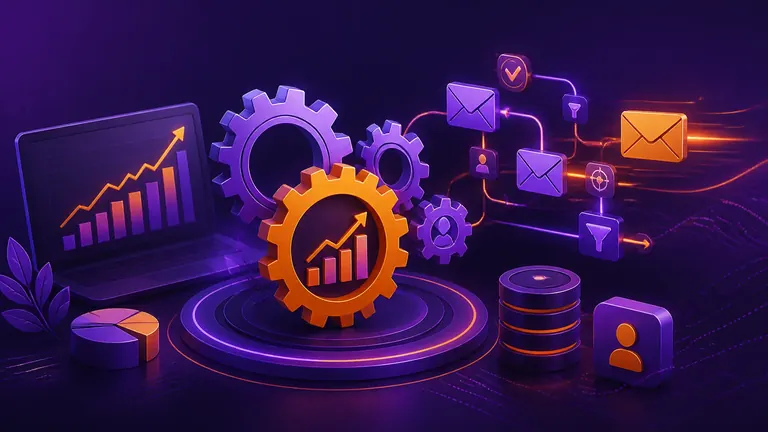
There comes a time when almost every company realizes the same problem: operations begin to grow, but the process continues to function as if it were still in an early stage. The team needs to respond manually, track contacts individually, remember follow-ups, organize opportunities, and maintain relationships almost on the fly.
While the volume is small, this seems manageable.
However, as the company gains momentum, the model begins to show its limits. Leads are lost, responses are delayed, opportunities cool off, and growth starts to depend on an increasingly greater operational effort.
It is at this point that marketing automation stops being an "advanced" tool and becomes a structural necessity.
Marketing automation is not just about automating messages
Many companies still see marketing automation as something limited to automatic email blasts or pre-made communication sequences. This view reduces a much deeper strategy to a simple operational execution.
In practice, marketing automation means creating a system capable of managing relationships at scale without losing context.
It organizes how leads enter, evolve, receive information, and progress along the journey. Instead of relying solely on manual action, the company begins to build processes that maintain consistency even when the volume increases.
This completely changes the operation.
The problem is not just generating leads — it’s sustaining the relationship
Most companies can attract attention. The challenge begins afterward.
The lead comes in, shows initial interest, and shortly after, disappears. Not because the product stopped making sense, but because the relationship was not sustained. There was a lack of continuity, follow-up, and context building throughout the process.
This is exactly where automation becomes crucial.
It allows the company to maintain contact strategically, delivering content, shaping perception, and preparing the lead for the decision moment. It’s not just about automatic communication. It’s about continuity.
Scaling without automation usually leads to disorganization
There is an important difference between growing and being able to sustain growth.
Companies that try to scale without automation often create a common scenario: more leads come in, but the operation does not keep up. The sales team becomes overwhelmed, returns become inconsistent, and the funnel loses efficiency.
The result is predictable.
Growth starts to generate disorganization instead of predictability.
Automation addresses this point. It reduces dependence on repetitive tasks and allows the team to focus energy on strategic decisions and more qualified opportunities.
Automation improves efficiency even before increasing conversion
One of the biggest mistakes in evaluating marketing automation is believing that it only serves to sell more.
In practice, it first improves the efficiency of the operation.
The company starts to respond faster, better organize the funnel, track lead behavior, and reduce losses along the journey. This creates a much more prepared environment for growth.
Over time, conversion improves as a consequence.
Because organized operations naturally perform better than operations that depend on improvisation.
When automation is poorly implemented, it pushes away instead of bringing closer
There is also an important problem: poorly built automation.
When a company automates without strategy, communication loses its naturalness. The lead perceives an excess of generic messages, context-less flows, and overly mechanical interactions.
In this scenario, automation stops strengthening relationships and starts to wear down perception.
Therefore, efficient automation is not the one that sends more messages.
It is the one that creates relevance at the right moment.
The role of automation within a modern funnel
Today, an efficient funnel directly depends on the company's ability to follow the lead throughout the journey.
Not every opportunity is ready to buy immediately. Many need to mature their understanding, recognize the problem, or gain confidence before the decision happens.
Automation allows sustaining this process without proportionally increasing operational effort.
It connects acquisition, relationship, and conversion within a continuous system.
Conclusion: marketing automation does not replace strategy; it supports strategy
In the end, marketing automation does not serve to make communication colder or replace human relationships.
It exists to allow the company to grow without losing consistency.
When well-structured, it reduces waste, improves efficiency, organizes the funnel, and creates continuity between marketing and sales. Growth stops depending solely on manual effort and begins to follow a much more sustainable process.
And that is exactly what growing companies need to build.
Kaizen structures automations that help companies grow with predictability
If your company already generates leads, has demand, and struggles to keep up with opportunities consistently, perhaps the problem is not in acquisition — but in the absence of a system that sustains that relationship over time.
Kaizen works by structuring performance-oriented automations, connecting funnel, qualification, relationship, and conversion within an operation prepared to grow.
If you want to transform manual processes into a more predictable and efficient structure, talk to Kaizen and understand how to implement marketing automation the right way.