
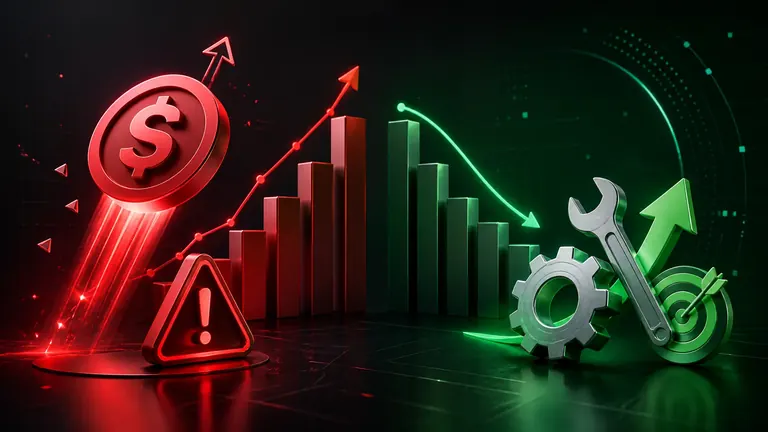
When Costs Rise, the Problem Is Rarely with the Campaign
At some point in operations, almost every company investing in marketing faces the same scenario: acquisition costs start to climb. Initially, this is interpreted as a one-off issue—a market variation, a creative that stopped performing, a necessary adjustment in the campaign. But over time, the increase persists, and what seemed like an exception begins to become the norm.
Also read about: Increasing Sales: Learn How to Boost Your Sales
It is at this moment that many decisions are made based on superficial readings. Ads are swapped, audiences are adjusted, new channels are tested. There is action, there is movement, but little structural change.
Because, in most cases, the problem is not with the campaign. It lies within the system that supports that campaign.
High CAC Is a Symptom of Inefficiency, Not Just Media Cost
CAC rarely rises on its own. It responds to how the operation is structured.
When a company starts paying more to acquire a customer, this can be linked to various factors that are not directly related to media: low conversion in the funnel, misalignment with the audience, unclear offers, or even an inefficient sales process. The final cost is merely a reflection of all this.
Also read about: Maximize Sales in the Digital Market: Practical Tips
That’s why trying to solve CAC by only looking at the top of the funnel tends to fail. The problem is not just how much it costs to attract someone, but how much it costs to turn that person into a customer.
And this difference completely changes the analysis.
The Market Gets More Expensive, but Not All Increases Come from Competition
There is a natural tendency to attribute the rise in CAC to the market. More competition, more competition for attention, more companies advertising. All of this undoubtedly impacts.
But this explanation, while valid, often hides a more critical point: the loss of internal efficiency.
When the funnel does not evolve, when conversion does not improve, and when the operation does not learn from the data, any increase in external costs becomes heavier. The company does not absorb the impact—it amplifies it.
More structured companies also face rising costs, but they can compensate with process improvements. Disorganized operations feel this impact much more aggressively.
Also read about: How a Performance Agency Can Increase ROI
CAC Rises When Conversion Does Not Keep Up with Growth
There is a direct relationship between CAC and conversion that is not always considered.
If the company generates the same volume of leads but converts less, the cost per customer automatically rises. This happens even if the cost per lead remains stable.
In other words, the problem may not be in acquisition, but in the ability to convert.
This is one of the most common reasons for the silent increase in CAC. The operation continues to invest, continues to generate leads, but loses efficiency along the funnel. And this loss accumulates until it appears in the final cost.
When this is not identified, the company tries to correct it in the wrong place.
The Mistake of Trying to Reduce Costs Without Increasing Efficiency
Faced with high CAC, the most common reaction is to try to reduce direct costs. Seeking cheaper leads, cutting investment, adjusting campaigns to lower the entry price.
But this approach has its limits.
Without improving efficiency, reducing costs at the entry point can mean reducing quality. And reducing quality generally impacts conversion even more, creating an opposite effect to what was expected.
The focus needs to shift.
Instead of trying to pay less for each lead, the company needs to understand how to extract more value from each lead that is already coming in. This is what, in the long run, sustainably reduces CAC.
Also read about: 7 Important Facts About Digital Marketing Companies
What Mature Companies Do Differently
Companies that manage to keep CAC healthy do not operate by only looking at media. They treat acquisition as part of a larger system.
They understand where the points of loss are, which profiles convert better, which channels generate real value, and how to optimize each step of the process. There is reading, there is control, and there is the ability to adjust.
This allows growth to happen more efficiently.
And efficiency is what protects CAC.
Conclusion: High CAC Is Not an Isolated Problem—It Is a Reflection of the System
In the end, CAC should not be analyzed as an isolated metric.
It is the final result of everything that happens beforehand: acquisition, qualification, guidance, conversion, and retention.
When it rises, the most important question is not how much it is costing, but why it is costing that much.
And that answer is rarely just in the campaign.
It lies in the structure.
Kaizen Structures Operations to Reduce CAC with Intelligence
If your company's CAC is increasing and attempts to adjust are not yielding consistent results, the problem may not be in the media—but in how the operation is structured.
Kaizen connects acquisition, funnel, data, and strategy to increase efficiency and reduce costs sustainably.
More than just decreasing investment, the focus is on improving the system.
If you want to understand what is driving your CAC up and how to strategically fix it, talk to Kaizen and start building a more efficient operation.