
Every company that sells online has a funnel. The difference is that, in some, it is structured, measured, and optimized. In others, it simply happens — without visibility, method, or control. The result is predictable: in the former, growth is planned. In the latter, it depends on luck.
The sales funnel is probably the most talked-about and least correctly applied concept in digital marketing. This article was written to change that. You will understand what a funnel is in practice, how to structure it from scratch, which metrics to track at each stage, and how to avoid the mistakes that hinder growth even in operations with a good budget.
What is a Sales Funnel in Digital Marketing
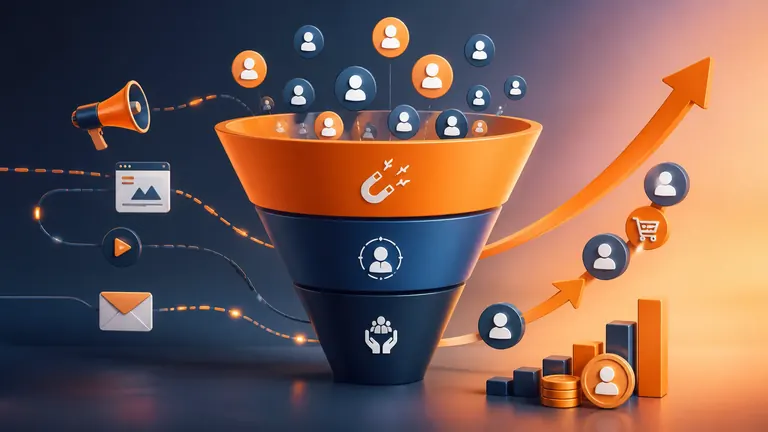
A sales funnel is the structured representation of the path a potential customer takes, from the first contact with the brand to becoming a customer — and ideally, a repeat customer. It is called a funnel because, naturally, the number of people decreases at each stage: many discover, some consider, few buy.
The function of the funnel is not to describe the customer — that is the task of the journey. The function is to organize the company's operation to respond, predictably, to each stage the customer is in.
A well-structured funnel answers three questions:
- Where is each lead within the process?
- What needs to happen for them to advance?
- Who is responsible for making that happen?
Without these answers, marketing and sales operate in the dark — and usually blame each other for the results.
The Classic Stages of a Funnel
The most commonly used structure in digital marketing divides the funnel into three large blocks, each with its own objective, content, and metrics.
Top of Funnel (ToFu) — Attraction
Here are the people who still do not know they need your solution. They have a problem, but may not have even named it yet. The goal of this stage is to generate qualified attention and educate.
- Typical content: blog articles, educational videos, social media posts, infographics.
- Channels: SEO, organic social media, awareness ads.
- Main metric: qualified reach and traffic from visitors with a matching profile.
Common mistake: trying to sell at the top. Those who barely know they have a problem are not ready to hear an offer.
Middle of Funnel (MoFu) — Consideration
At this stage, the person recognizes the problem and is evaluating solutions. They compare, research, download materials, open emails, and follow the brand. The goal is to build trust and differentiate your solution.
- Typical content: e-books, webinars, case studies, comparisons, email sequences.
- Channels: marketing automation, remarketing, lead nurturing.
- Main metric: conversion rate from visitor to lead and engagement of generated leads.
Common mistake: treating every lead the same. In the middle of the funnel, segmentation is what separates efficient nurturing from disguised spam.
Bottom of Funnel (BoFu) — Decision
Here the lead is ready to buy — or very close to it. They have understood the problem, compared options, and want security to decide. The goal is to remove objections and close the sale.
- Typical content: demonstrations, proposals, testimonials, guarantees, commercial offers.
- Channels: sales team, commercial WhatsApp, offer emails, conversion ads.
- Main metric: closing rate and customer acquisition cost (CAC).
Common mistake: prolonging the stage with excessive information. At the bottom of the funnel, clarity sells more than volume.
The Stage That Almost No One Structures: Post-Sale
The traditional funnel ends at the sale. Mature operations include a fourth stage: retention and expansion. This is where the best long-term results are, because selling again to someone who has already bought costs much less than acquiring a new customer.
- Typical content: onboarding, usage materials, loyalty programs, referrals.
- Main metric: LTV, repurchase rate, and NPS.
How to Structure a Sales Funnel from Scratch
Structuring a funnel does not start with a tool. It starts with a strategic decision. The sequence we apply at Kaizen Agency is:
1. Define the revenue goal and work down to the metric
How much does the company need to earn? How many customers does that represent? How many leads are needed to generate those customers? How many visitors to generate those leads? This reverse calculation transforms goals into operations.
2. Map the real customer journey
A funnel without a journey is a structure without a soul. Before defining stages, it is necessary to understand how the customer really decides — what they research, in what order, who they talk to, what holds them back. (This work is detailed in our article on the customer journey.)
3. Define objective criteria for each stage
When does a lead stop being ToFu and become MoFu? When do they become BoFu? Without clear criteria, each team member classifies in their own way — and the entire operation becomes imprecise. Typical criteria involve behavior (pages visited, materials downloaded, emails opened) and profile (position, segment, size).
4. Structure content and offers for each stage
Each stage needs at least one content asset and a clear offer for advancement. If the lead reaches the middle of the funnel and there is nothing to deliver to them, the operation stalls.
5. Integrate marketing and sales with a clear handoff
Define the exact moment when the lead passes from marketing to sales, and what needs to be recorded in that transition. Most operations lose money in the transition between the two areas, not within them.
6. Implement measurement at each stage
Without measurement, there is no optimization. Each stage needs a main metric and a conversion rate to the next. This is what will show where the real bottleneck is.
The Metrics That Matter at Each Stage
A funnel measures progress, not activity. The metrics that support decision-making are:
- Qualified visitors (top)
- Conversion rate from visitor → lead (top to middle)
- Conversion rate from lead → MQL (marketing qualified lead)
- Conversion rate from MQL → SQL (sales qualified lead)
- Closing rate from SQL → customer
- Customer acquisition cost (CAC)
- Average ticket
- Sales cycle time
- LTV and repurchase rate (post-sale)
A healthy funnel is not one that has high volume at the top. It is one that has consistent conversion rates between stages.
The Most Common Mistakes When Structuring a Funnel
In projects we take on to restructure, the same problems appear:
- Funnel only for marketing. Without integration with sales, good leads are wasted.
- Giant top and empty bottom. Lots of traffic, little conversion. Usually, it is an offer problem, not a traffic problem.
- Lack of criteria for qualification. Leads without clear criteria clog the sales team.
- Unbalanced content. Excessive top material, scarcity of bottom material.
- Measuring activity, not progress. The number of emails sent is not a funnel metric. Conversion between stages is.
- Forgetting post-sale. Stopping at the sale leaves revenue on the table.
The Role of Automation and Artificial Intelligence
A structured funnel scales with technology. Automation allows each lead to receive the right content, in the right channel, at the right time, without relying on manual execution. AI takes this to another level:
- Intelligent lead scoring that classifies leads by real probability of purchase.
- Dynamic personalization of content and offers by stage.
- Conversion prediction based on historical behavior.
- Detection of leads at risk of cooling off before it happens.
- Continuous optimization of messages, channels, and timing.
Without automation, the funnel only works on a small scale. With well-implemented automation, it becomes a machine of predictability.
Conclusion
The sales funnel is not a drawing with arrows in a slide presentation. It is the operational structure that separates companies that grow by method from those that grow by luck. Structuring it well requires clarity of objective, real knowledge of the customer, objective qualification criteria, appropriate content for each stage, and consistent measurement.
The right question is not “Do you have a funnel?”. Every company has one. The question is “Can you describe, with numbers, what happens at each stage of your funnel today?”. Those who answer yes scale. Those who answer no pay more for each sale — and don’t even know where they are losing.
FAQ
1. What is the difference between a sales funnel and the customer journey? The funnel is the company's view of the sales process. The journey is the customer's view of the buying experience. The two complement each other, and mature operations work with both integrated.
2. Does every company need a structured funnel? Yes, but the complexity varies. Small operations can have simple funnels, with few stages and basic tools. The essential thing is to have clarity of stages, criteria, and metrics — regardless of size.
3. What tools are necessary to operate a funnel? A typical stack includes CRM, marketing automation platform, analysis tool (like GA4), and integrated communication channels (email, WhatsApp, ads). The important thing is integration, not quantity.
4. How long does it take for a funnel to start generating results? Well-structured funnels begin to show useful data in 30 to 60 days. Consistent optimization and compounded gains appear between 3 and 6 months, depending on the business's sales cycle.
5. How can I tell if my funnel is healthy? Look at the conversion rates between stages, not just the total volume. A healthy funnel has balanced conversion from start to finish, controlled CAC, and increasing LTV. Imbalances between stages indicate where the bottleneck is.
About Kaizen Agency
Kaizen Agency structures digital marketing operations focused on predictability, automation, and sustainable growth. We transform diffuse funnels into clear processes, and clear processes into predictable revenue.
Want to structure a sales funnel that generates predictable results? Talk to Kaizen. [blocked]