
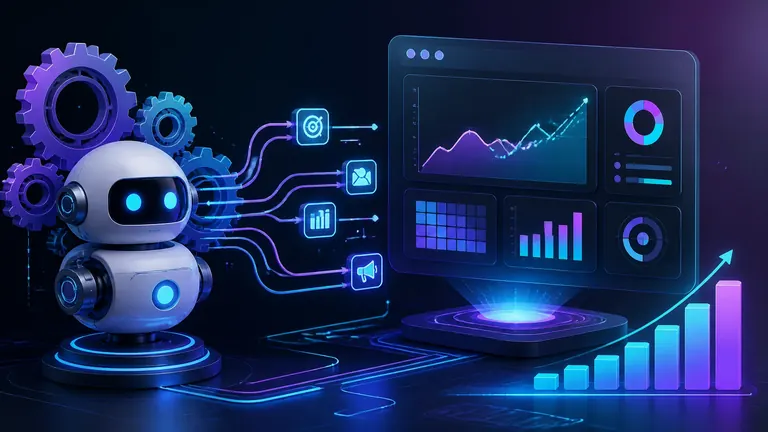
For a long time, marketing automation was treated as synonymous with automatic email flows. Today, this view has become limited. The combination of marketing automation and artificial intelligence has changed how companies capture, qualify, convert, and retain customers — and those who understand this in practice stop operating on improvisation and start building predictable growth.
This guide was written for marketing professionals, managers, and entrepreneurs who have tried to automate processes but feel that clarity, strategy, and real results are lacking. Here you will understand, based on projects we conducted at Agência Kaizen, how this integration works, where it fails, and how to apply it without falling into trends.
What is marketing automation (and what it is not)
Marketing automation is the technological structure that allows executing communication, qualification, and relationship actions based on triggers, rules, and predefined journeys. In simple terms: the system acts on its own based on user behaviors.
But automation is not just email blasting. It involves:
- Lead capture and segmentation
- Lead scoring (scoring by profile and behavior)
- Multichannel nurturing (email, WhatsApp, SMS, push, ads)
- Integration with CRM and sales teams
- End-to-end journey measurement
When well implemented, it reduces repetitive manual work and standardizes operations. When poorly implemented, it becomes a noise generator — infinite flows, out-of-context messages, and leads treated as numbers.
What changes when AI enters the operation
Artificial intelligence does not replace automation. It adds a decision-making layer over the automated structure. Instead of following only fixed rules, the system starts to learn from data and adjust its responses.
In practice, AI applied to marketing automation acts on four main fronts:
- Intelligent lead classification — analyzes historical patterns and identifies who has the highest real probability of purchase.
- Personalization at scale — adapts messages, offers, and timings by profile, without relying on manual rules for each scenario.
- Behavior prediction — anticipates churn, repurchase, abandonment, and upsell opportunities.
- Continuous optimization — tests variations, identifies what works, and adjusts flows automatically.
The difference is structural: traditional automation executes what was programmed. AI-powered automation interprets context and responds adaptively.
Why this integration became indispensable in 2026
Three market movements have made this combination mandatory for companies that want to grow:
1. Rising acquisition costs. Paid traffic has become more expensive on almost all platforms. This forces companies to extract more value from each lead that comes in — and this is only possible with intelligent qualification and personalization.
2. Communication saturation. Users receive hundreds of messages a day. Generic content is ignored. Only contextual and relevant communication generates a response.
3. Experience expectation. B2B and B2C consumers compare any brand with the best digital experiences they have ever had. Slow, uncoordinated, and impersonal operations lose ground.
AI-powered automation directly addresses these three points.
How to apply in practice: from diagnosis to execution
Most automation projects fail not because of technology, but due to the absence of method. At Agência Kaizen, we work with a clear sequence, validated in dozens of operations:
1. Funnel diagnosis
Before automating anything, it is necessary to map:
- Traffic sources and the quality of each source
- Conversion and abandonment points
- Average time between stages
- Current qualification criteria
- Integration between marketing and sales
Without this map, automation becomes a scale of confusion.
2. Defining journeys and triggers
This is where the system's logic is drawn: what each behavior triggers, what content enters each stage, when the lead goes to sales, and when it returns to nurturing.
3. Technical implementation
Platform selection, CRM integration, event configuration, lead scoring, and flows. This is the operational part — and the one that consumes the most time.
4. Activating the AI layer
With the base functioning, the intelligence resources come in: predictive scoring, content recommendation, dynamic segmentation, churn prediction, and timing optimization.
5. Continuous measurement and adjustment
AI-powered automation is not a project, it is a process. Indicators need to be reviewed weekly, and flows adjusted according to the real behavior of the audience.
Where AI delivers the most value today
Based on what we see in real operations, these are the uses with the most proven impact:
- Predictive lead scoring: prioritizes what the sales team should attack first.
- Email and landing page personalization: increases conversion rates without increasing content production.
- Churn detection: identifies at-risk customers before cancellation.
- Assisted content generation: accelerates production without losing editorial consistency.
- Intent analysis in forms and chats: qualifies leads in real-time.
It is worth noting: not every feature sold as "AI" delivers real intelligence. Many platforms have rewrapped old automations with a new name. The criterion for evaluation is simple — does the tool support better decisions or just execute faster?
The most common mistakes (and how to avoid them)
In projects we take on to restructure, the same mistakes repeatedly appear:
- Automating before organizing. Without a clear process, technology scales chaos.
- Treating all leads the same. A single flow for different origins destroys conversion.
- Confusing volume with results. Sending more does not mean selling more.
- Ignoring marketing-sales integration. Poorly passed qualified leads are lost leads.
- Not reviewing flows. Forgotten automation becomes passive, not active.
The human role in this new logic
AI-powered automation does not replace the marketing team. It frees the team for what really matters: strategy, creation, analysis, and positioning decisions. Repetitive manual work disappears. Intellectual work expands.
Companies that understand this stop measuring productivity by the volume of tasks executed and start measuring by the quality of decisions and speed of response to the market.
Conclusion
Marketing automation and artificial intelligence, together, have ceased to be a competitive differential to become a minimum standard in operations that want to grow with predictability. It is not about adopting technology for trend's sake, but about building a system capable of learning, adapting, and delivering real value in every interaction.
The question has changed from "Is it worth automating?" to "How much longer can your operation last without it?".