
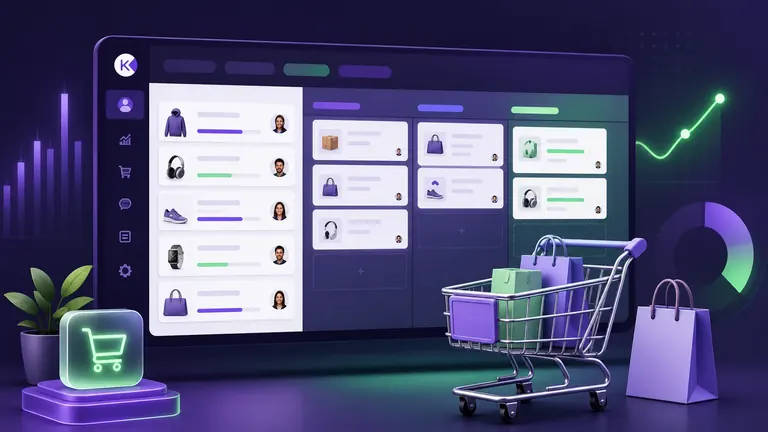
The Real Scenario of Modern E-commerce
Kommo for E-commerce: The Solution for Efficient Communication
An e-commerce today doesn't just sell with a buy button. It sells through conversation. The customer sees the product on Instagram, asks on WhatsApp about delivery time, wants to know if they can exchange it, asks about size, payment conditions, shipping, delivery. The decision doesn't happen just at checkout; it happens in the conversation.
The problem is that most online stores still operate with scattered messages, agents responding from different phones, and no clear view of the customer's history. This raises the question about Kommo: does a CRM designed for conversations really make sense for an e-commerce?
The answer is yes, because it acts precisely where the store's platform does not: in the relationship and organization of communication.
Where the E-commerce Platform Stops, Kommo Begins
Systems like Shopify, WooCommerce, or Magento are excellent for catalog, payment, and inventory. But they were not created to organize conversations, track inquiries, or structure the sales process before the purchase. They handle the transaction. Kommo handles the relationship.
When the customer contacts via message, this is not just support; it is an ongoing sales opportunity. Kommo transforms each conversation into an item in the funnel, with history, responsible party, and next action. What was once just a message exchange becomes a sales process.
The Centralization of Messages Changes the Game
One of the biggest bottlenecks in e-commerce is fragmented communication. WhatsApp on one side, Instagram on another, website chat separate, lost emails. This creates rework, conflicting responses, and opportunities that simply vanish.
In Kommo, all conversations enter a single environment. Any team member can see the complete customer history before responding. This reduces errors, increases consumer trust, and greatly improves the experience. For the customer, the store seems more professional. For the company, service stops being improvised.
The Sales Funnel Applied to E-commerce
Even in a virtual store, there is a journey before the purchase. The customer goes through interest, doubt, comparison, decision. When this is not mapped, the company does not know where it is losing sales.
With Kommo, the e-commerce can structure a funnel that represents this path. Each lead that comes in through a message is positioned in a stage. The team can see how many conversations are hot, which are stalled, and where to act. This transforms the CRM into a strategic tool, not just organizational.
Automation as an Ally of Conversion
In e-commerce, the volume is large and questions repeat. Automation is not a luxury; it is survival. Kommo allows you to set up automatic responses outside of business hours, flows that qualify the customer, follow-up reminders, and actions based on behavior.
This does not replace human service but frees up time for it to act where it truly impacts sales. The company stops relying on the memory of agents and starts having a process that works even when the movement increases.
The Difference Between Using Isolated Chat and Using Kommo
Chat tools only solve communication. Kommo solves communication plus process. The conversation does not remain loose; it becomes part of a funnel, with responsibility and next action defined. This reduces the loss of opportunities and provides managerial insight into what is happening.
Compared to traditional CRMs that do not have integrated messaging, Kommo prevents the team from speaking in one system and recording in another. Everything happens in the same place, which reduces friction and increases adoption.
Where Kommo Really Makes an Impact in E-commerce
It improves conversion because it organizes pre-sale. It enhances the experience because it maintains history and context. It helps with retention because it allows tracking post-sale. And most importantly, it gives control over something that many e-commerce businesses cannot measure: the conversations that precede the purchase.
This is where many sales are lost. And it is exactly where Kommo operates.
Limits That Need to Be Understood
Kommo does not replace sales platforms, financial systems, or inventory management. It also requires initial configuration, funnel definition, and team training. But as a customer relationship hub, it is extremely effective for online stores that rely on interaction to convert.
Conclusion
Kommo works for e-commerce because it solves the weakest link in the digital operation: organized communication that leads to sales. It connects messages, history, team, and process, transforming service into an active part of the commercial strategy.
If you want to implement Kommo in your e-commerce in a structured way, with a well-defined funnel, smart automations, and integration with your channels, Kaizen can help transform the CRM into a sales machine aligned with your business growth.
Want to implement Kommo CRM in your e-commerce? Kaizen is an official Kommo partner and offers complete integration solutions for online stores.
Want to implement Kommo CRM in your e-commerce? Kaizen is an official Kommo partner and offers complete integration solutions.
More About Kommo CRM
Check out other articles from our complete guide on Kommo CRM:
- How to Configure Kommo CRM to Maximize Sales — Complete configuration guide
- What is the Best Plan for Kommo CRM for Your Business — Choose the ideal plan
- Kommo CRM: Updated Prices and Benefits — Updated prices
- Kommo CRM Integration with WhatsApp — Practical guide
- Kommo CRM for Small Businesses — Is it worth it?
- Kommo for E-commerce — How it works
- CRM for Marketing Agencies — Why have your own
- How to Reset Kommo CRM — Complete step-by-step
- Amo CRM (Kommo CRM) — Complete guide of the old name