
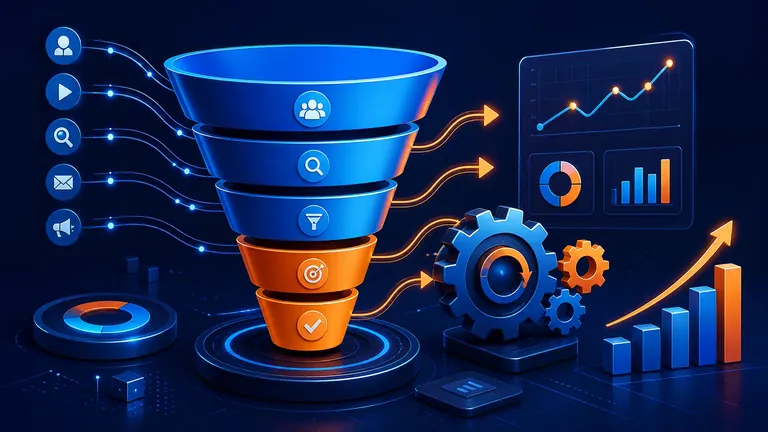
The mistake is not the absence of a funnel, but how it is built
Most companies already work with some type of sales funnel.
There is a defined journey, organized stages, implemented tools, and in many cases, even automations working. From a structural point of view, it seems that everything is in place.
Still, the results do not follow.
Leads come in, the process happens, but the conversion does not sustain the expected growth. This generates a common feeling: that the funnel exists, but does not work as it should.
This problem is not the lack of a funnel. It is in how it was conceived.
A funnel that converts is not a sequence of stages — it is a transformation system
One of the most frequent mistakes is treating the funnel as a linear structure. Something that starts with lead generation, goes through some stages, and ends with a sale.
In practice, an efficient funnel is not just a path. It is a system that transforms perception into decision.
This means that each stage needs to fulfill a specific role: reduce uncertainty, increase understanding, generate trust, and prepare the next move of the customer.
When this logic does not exist, the funnel becomes just a mandatory passage. The lead goes through stages but does not evolve in clarity. And without evolution, there is no consistent conversion.
Also read about: Opportunities with Lead Generation
Conversion happens when context is built, not when the offer is presented
Many operations try to improve conversion by adjusting the end of the funnel.
They change the sales approach, refine the pitch, train the sales team. There is effort to improve closing, but little attention to what happens before it.
The problem is that the decision does not happen at the moment of sale.
It starts much earlier.
If the lead arrives without understanding the problem, without recognizing value, and without sufficient context, any attempt at conversion becomes more difficult. The sales team needs to compensate for what was not built throughout the journey.
A funnel that truly converts organizes this process. It prepares the lead before the sale happens.
Also read about: The Step-by-Step of Lead Qualification
When the funnel is right, the effort decreases
There is a simple but powerful indicator that a funnel is working: the effort required to convert decreases.
The lead arrives more aware, objections are more specific, the conversation flows more naturally. The salesperson does not need to convince from scratch. They need to guide.
This type of scenario does not happen by chance. It is the result of a funnel that fulfills its function throughout the journey.
When this does not happen, the effect is the opposite. Each sale requires more energy, more explanation, and more time. The process becomes heavy, and growth starts to depend on constant effort.
Also read about: How content marketing can generate more leads?
Structuring a funnel requires understanding behavior, not just defining stages
A common mistake is to design the funnel based on the internal logic of the company, not the customer experience.
Stages are defined based on operational organization, but not necessarily on how the customer thinks, decides, and advances.
This creates misalignment.
The funnel may be well organized internally, but it does not align with how the market behaves. And when this happens, conversion suffers.
Structuring an efficient funnel requires looking at the customer's decision-making process: what doubts arise, what barriers appear, what generates trust, and what hinders progress.
Without this understanding, any structure tends to be superficial.
Also read about: Feeding, Capturing, and Generating Leads with Digital Marketing
The critical point is between entry and advancement
Most companies can generate leads.
The real challenge is to make those leads advance consistently.
This space — between entry and decision — is where the funnel really happens. And it is also where the biggest bottlenecks are.
When this transition is not clear, the lead enters but does not evolve. They get stuck, lose interest, or depend on external stimuli to continue.
A funnel that converts organizes this transition. It guides, directs, and keeps the lead moving forward.
Without this, growth remains limited.
Also read about: Lead generation: strategies that a digital agency
Predictable conversion comes from process, not isolated effort
Companies that can convert consistently do not depend on specific campaigns or isolated moments.
They build a process.
They know how many leads come in, how many advance, where the losses are, and how to optimize each stage. There is clarity, control, and the ability to adjust.
This allows for result prediction.
And predictability is what sustains scale.
Without it, any growth tends to be unstable.
Conclusion: a funnel that converts is not what exists — it is what guides
Having a funnel does not mean having a conversion structure.
What defines the result is the ability of this funnel to guide the lead throughout the journey, reducing uncertainty, building context, and preparing the decision.
When this happens, conversion stops depending on effort and starts to follow a more natural logic.
When it does not happen, the funnel exists, but does not fulfill its role.
And in this scenario, growing becomes increasingly difficult.
Also read about: How to generate leads for construction companies: essential strategies
Kaizen structures funnels that truly transform leads into customers
If your company already generates leads, has a defined funnel, and still cannot convert consistently, the problem may not be in generation — but in how the process was structured.
Kaizen works on building performance-oriented funnels, connecting acquisition, journey, sales approach, and data to create a system that truly converts.
More than organizing stages, the focus is on structuring the transformation.
If you want to move from a funnel that merely receives leads to a model that generates sales predictably, talk to Kaizen and start structuring real growth.