
The problem for many companies is not a lack of data. It's an excess of disconnected information.
As an operation grows, a huge amount of information starts to circulate at the same time. Leads come in through different channels, campaigns generate reports, sales records negotiations, tools capture behavior, and platforms accumulate metrics at a constant pace.
At first glance, it seems that the company finally has everything it needs to make better decisions.
But in practice, the scenario is often different.
The data exists, but it is scattered. Marketing interprets one part, sales works with another, and management tries to connect information that rarely communicates with each other. The result is an operation that generates a lot of movement but little clarity.
It is precisely at this point that integration stops being a technical detail and becomes a growth structure.
CRM alone does not solve predictability
For a long time, many companies treated CRM as the definitive solution for commercial organization. The implementation of the tool seemed sufficient to generate control over the sales process.
However, after the initial excitement, a common perception begins to emerge: CRM organizes information, but does not necessarily transform that information into operational intelligence.
Without integration with marketing, behavior, and automation, it runs the risk of becoming just a repository of contacts and negotiations.
The problem was never just storing data.
The real challenge is to transform data into strategic reading.
AI begins to change how companies interpret behavior
The entry of artificial intelligence into commercial and marketing operations changes precisely this point.
While traditional CRM records movements, AI begins to interpret patterns. It identifies behavior, recognizes intent signals, cross-references information, and helps transform isolated activities into context.
This profoundly changes the operational logic.
The company stops reacting only to what happened and begins to build the capacity for anticipation. The lead is not analyzed only by the stage of the funnel but by behavior throughout the journey.
And this drastically increases the quality of decisions.
Marketing loses efficiency when working without a complete view of the journey
There is a silent problem in many performance operations: marketing works looking only at acquisition.
Campaigns are evaluated by clicks, leads, or reach, but there is little clarity about the real behavior of these opportunities after they enter the funnel. Sales closes some deals, loses others, but the learning rarely returns to marketing in a structured way.
In this scenario, the operation grows without accumulating intelligence.
The integration between CRM, AI, and marketing precisely resolves this rupture. It creates continuity between attraction, behavior, and conversion. Marketing stops optimizing only entry and starts to understand the real quality of opportunity.
Integration reduces invisible waste
A large part of commercial inefficiency does not appear immediately in reports.
It is in the details: leads that cool off without follow-up, poorly distributed opportunities, lost timing, campaigns that generate volume without adherence, and decisions made with little contextual vision.
When AI, CRM, and marketing operate in an integrated manner, these wastes begin to decrease.
The company gains response speed, improves prioritization, identifies bottlenecks earlier, and reduces dependence on subjective perception within the operation.
This not only improves efficiency.
It improves predictability.
The future of performance operations will be based on connected intelligence
There is an important transformation happening in the market.
For a long time, companies grew by adding more tools, more campaigns, and more channels. Now, the differential begins to migrate to another place: the ability to connect all of this intelligently.
The most efficient operations are not necessarily the ones with the most technology.
They are those that can integrate technology, behavior, and decision-making within a single operational flow.
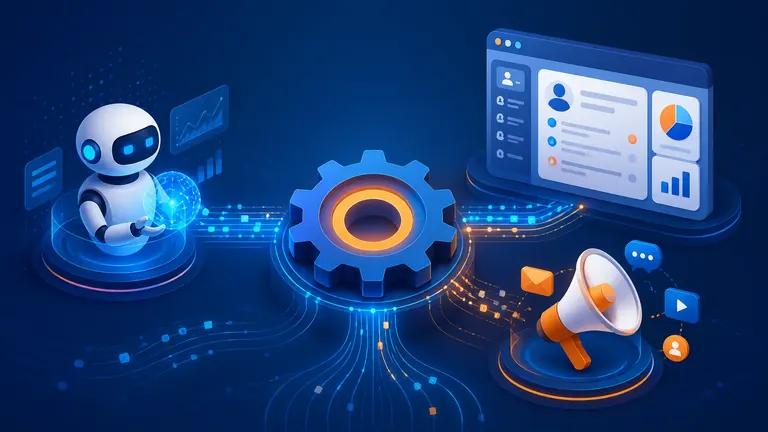
AI accelerates interpretation. CRM organizes context. Marketing generates movement. But the real gain appears when these three layers start to work together.
The mistake of implementing technology without operational structure
There is also an important point that many companies ignore: technological integration does not correct the absence of process.
When the funnel is confusing, positioning is misaligned, or sales operates without clear criteria, technology only amplifies complexity. The company ends up having more information but not necessarily more clarity.
Therefore, performance-oriented operations do not start with the tool.
They start with the operational logic that supports that tool.
Real performance arises when marketing and sales share intelligence
Perhaps the greatest impact of this integration lies precisely in the relationship between marketing and sales.
When both areas start to operate on the same data, the same signals, and the same quality criteria, the company reduces internal noise and increases its capacity for learning.
Marketing understands better what generates sales. Sales receives more contextualized opportunities. Management begins to interpret the funnel with much more precision.
And this transforms performance into a system, not an attempt.
Conclusion: integrating AI, CRM, and marketing is integrating operational intelligence
The market is rapidly moving towards more connected, smarter operations that are less dependent on manual effort and isolated interpretation.
Companies that continue to treat marketing, CRM, and sales as separate areas tend to lose efficiency over time. On the other hand, operations that can integrate behavior, data, and decision-making begin to build something much more valuable: predictability.
In the end, integration is not just technology.
It is operational maturity.
Kaizen helps companies structure smarter and more integrated operations
The integration between AI, CRM, and marketing requires much more than technical implementation. It depends on strategy, funnel structure, and clarity on how to transform data into growth.
Kaizen connects acquisition, automation, CRM, AI, and performance to build operations capable of generating more efficiency, more predictability, and much smarter decisions.
If you want to transform your operation into a system truly oriented towards performance, talk to Kaizen and discover how to integrate technology and strategy the right way.