
What Separates the Performance Discourse from the Real Operation
Performance marketing is one of the most used terms in the market and also one of the most misunderstood.
In most companies, it is still associated with paid traffic campaigns, lead generation, and ad optimization. There is a perception that it is enough to invest in media, track some metrics, and adjust creatives for results to happen.
But this is a superficial view.
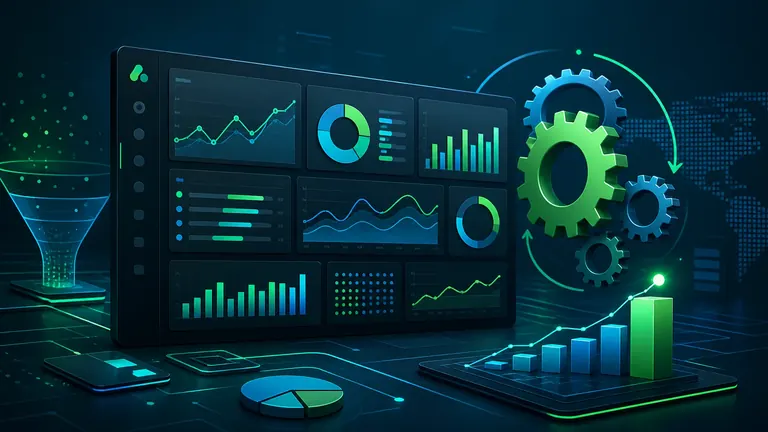
In practice, performance marketing is not about campaigns. It is about building a system capable of transforming investment into predictable growth. And this involves much more than media.
A performance-oriented operation does not start with the campaign. It starts with the logic of the business.
Read more about the topic here: How to Choose the Best Performance Agency in 2026
Performance Marketing Starts Before the First Click
In a mature operation, performance is not a stage of marketing. It is a principle that guides all decisions.
Before any campaign goes live, there is work that rarely appears but defines almost all results:
- clarity about the product and the offer
- definition of the ideal customer profile
- understanding of the buying process
- alignment with the sales team
- structuring the funnel
Without this, media becomes just an amplifier of inconsistencies.
When this foundation is not well defined, marketing can generate volume but cannot generate efficiency. And it is at this point that many companies confuse activity with performance.
The Role of Media: Accelerating What Already Works
A performance-oriented operation does not use media to discover if something works. It uses media to scale what has already been proven to work.
This completely changes the logic.
Instead of relying on trial and error, the company works with validation. Before increasing investment, it seeks clear signals of:
- offer adherence
- market response
- conversion consistency
- demand quality
When these signals exist, media acts as an accelerator. When they do not exist, it only increases the cost of error.
That is why two companies can invest similar amounts and have completely different results. The difference is not in the platform. It is in the structure.
Learn more about the topic here: What Does a Performance Agency Do?
The Logic of Operation: Data That Generates Decisions, Not Just Monitoring
In many operations, data exists but is not used correctly. They serve to track what happened but not to guide what should be done.
A real performance operation works differently.
Data are not just metrics. They are inputs for decision-making.
This means that each number needs to answer a business question:
- Does this lead have real quality?
- Does this channel generate revenue or just volume?
- Is this investment reducing or increasing CAC?
- Is this funnel evolving or just moving?
Without this reading, marketing becomes a dashboard full of indicators but empty of direction.
Read more about: What is a Performance Agency?
Where Most Companies Go Wrong in Practice
The problem is not the lack of tools or channels. It is in how the operation is conducted.
Many companies structure marketing as a set of isolated actions:
- traffic runs on one side
- sales operate on another
- data remains disconnected
- decisions are reactive
In this scenario, each area fulfills its role, but the system as a whole does not work.
Performance requires integration.
When marketing and sales are not aligned, the impact is direct. Marketing generates leads that do not convert, sales complain about quality, and the company enters a cycle of superficial adjustments without addressing the real cause.
What Defines a Truly Performance-Oriented Operation
A performance operation is not one that runs campaigns. It is one that builds predictability.
This happens when there is a connection between:
- acquisition (how the lead arrives)
- conversion (how it advances)
- closing (how it becomes a customer)
- retention (how much it is worth over time)
When these stages are integrated, growth ceases to depend on peaks and begins to follow a more stable logic.
The company starts to understand how much it needs to invest to generate a certain result. It can predict scenarios. It can make decisions with more confidence.
And it is at this point that performance marketing ceases to be execution and becomes strategy.
Read more about the topic: How a Performance Agency Can Increase ROI
Predictable Growth Is Not the Result of a Campaign, It Is the Result of a System
Perhaps the biggest mistake is believing that performance marketing is linked to campaigns that work well.
Campaigns are important, but they are just part of the process.
What sustains real growth is a system:
- with clear logic
- with metrics connected to the business
- with defined processes
- with the capacity for learning and repetition
Without this, any positive result tends to be isolated. And isolated results do not scale.
Companies that grow consistently do not depend on isolated successes. They build an environment where success can be replicated.
Read more about the topic: Why Hire a Performance Agency in 2026
Conclusion: Performance Marketing Is Less About Executing and More About Structuring
In practice, performance marketing is not a tool. It is a way of operating.
It requires less focus on isolated actions and more attention to the coherence between strategy, execution, and business numbers. It requires less trial and more understanding. Less volume and more direction.
When well applied, it transforms marketing into a predictable growth engine.
When poorly applied, it becomes just an active operation, but not very efficient.
The difference between one and the other lies in the foundation.
Kaizen Can Structure Your Operation to Generate Predictable Growth
If your company is already investing in marketing but still cannot transform effort into consistent results, the problem may not be in execution — but in structure.
Kaizen works on building performance-oriented operations, connecting acquisition, funnel, data, and strategy to generate predictable and sustainable growth.
More than running campaigns, the focus is on creating a system that allows scaling with clarity, control, and efficiency.
If you want to move from a trial-based operation to a results-oriented model, it is worth understanding where the bottlenecks in your structure are. Talk to Kaizen and start building real growth.