
Every sale is the result of a sequence of decisions. The customer perceives a problem, seeks information, compares options, hesitates, returns, decides, and — if all goes well — buys. This path is not linear, it is not the same for everyone, and it almost never happens as the marketing team imagines. Understanding this real journey is what we call the customer journey, and mastering it is one of the most underestimated skills in digital marketing.
This article is written for professionals who have heard of the concept but want to go beyond the pretty diagram. Here you will understand what the customer journey is in practice, how to map it usefully, and how to turn that mapping into decisions that generate revenue.
What is the customer journey
The customer journey is the set of stages, interactions, and emotional states that a person goes through from the first contact with a problem until after the purchase. It includes Google searches, conversations with friends, website visits, ads seen, emails received, questions on WhatsApp, comparisons with competitors, and the post-sale experience.
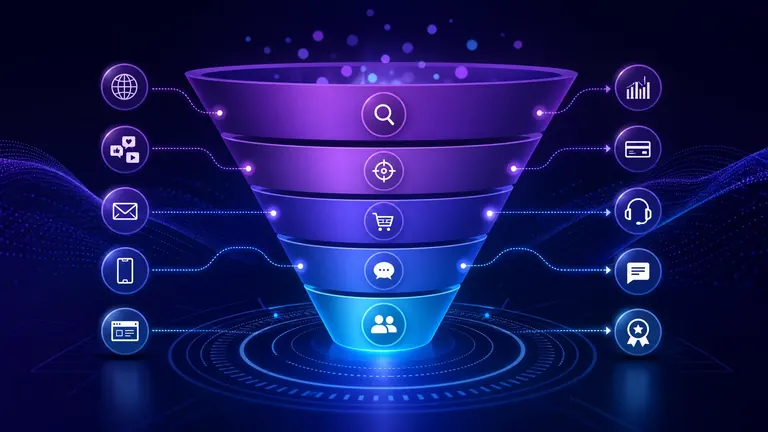
It is not the same as the sales funnel. The funnel describes how the company sees the process. The journey describes how the customer experiences the process. They are complementary perspectives — and mature operations work with both.
The typical journey usually involves four major moments:
- Discovery — the person realizes they have a problem or need.
- Consideration — seeks information, compares, evaluates options.
- Decision — chooses a solution and makes the purchase.
- Post-sale — uses the product, forms an opinion, returns or recommends.
At each moment, they have different questions, different objections, and different preferred channels. The marketing job is to find that person where they are, with the message that makes sense at that stage.
Why mapping the journey matters
Without mapping, communication becomes shooting in the dark. You talk about price to someone who hasn’t even understood the problem yet. You send educational content to someone who is already ready to buy. You insist on sales to someone who needs support. Each mismatch between the message and the customer’s stage costs conversion.
Operations that map the journey seriously can:
- Identify friction points that block sales.
- Discover invisible bottlenecks between funnel stages.
- Personalize communication by stage, not by guesswork.
- Allocate media budget based on real impact, not on assumptions.
- Anticipate objections and address them before they turn into abandonment.
The difference between an operation that maps and one that does not is rarely technology. It’s clarity.
How to map the customer journey in practice
Mapping the journey is not about drawing a pretty diagram to present in a meeting. It is a methodical work of investigation, validation, and synthesis. At Kaizen Agency, we follow a clear sequence:
1. Define the real persona (not the idealized one)
Before the journey comes the character. A persona is not a generic demographic profile. It is a synthesis based on interviews, CRM data, and real behavior analysis of your best customers. The more specific, the more useful.
Ask yourself:
- Who are the customers that generate the most revenue and stay the longest?
- What did they have in common before buying?
- What real problem led them to seek a solution?
2. List the touchpoints
Map all the points where the customer interacts with the brand: Google, social media, ads, website, blog, email, WhatsApp, chat, phone calls, physical store, post-sale. Each point is an opportunity — or a friction.
3. Identify triggers and barriers at each stage
For each moment of the journey, answer:
- What motivates the customer to move forward?
- What holds them back or makes them give up?
- What doubts do they have at this stage?
- What proof or information unlocks the decision?
This layer is what differentiates useful mapping from decorative diagrams.
4. Combine quantitative and qualitative data
Solid mapping crosses two types of information:
- Quantitative: data from Google Analytics, CRM, automation, ads. They show what happens.
- Qualitative: interviews with customers, analysis of service conversations, surveys, session recordings. They show why it happens.
Operations that only look at numbers see half the journey.
5. Visualize the journey in a usable way
The final map should be clear enough for anyone on the team to understand in seconds. Include: stage, customer objective, typical actions, channels used, doubts and objections, marketing opportunities, and associated metrics.
If the map ends up in a forgotten folder, it has become decoration. If it is consulted in decision-making meetings, it has become a tool.
How to optimize the journey after mapping
Mapping is the beginning. Optimizing is where the results are. The moves with the greatest impact are:
1. Eliminate obvious frictions. Long forms, unnecessary steps, lack of information at critical moments, slow websites, uncoordinated service channels. Each friction removed releases accumulated conversion.
2. Add proof points at the right moments. Testimonials, case studies, guarantees, data, certifications. The secret is to insert each proof at the stage where it addresses a real objection, not to spread them everywhere.
3. Personalize communication by stage. Those discovering the problem need education. Those comparing need differentiation. Those deciding need reassurance. A single message for all stages is wasteful.
4. Integrate channels. Customers do not distinguish marketing, sales, and support — they see one brand. When channels do not communicate with each other, the journey breaks. Integration between CRM, automation, and service is fundamental, not a luxury.
5. Take care of post-sale as part of the journey. The sale does not end at the sale. The post-sale determines repurchase, referrals, and LTV. Operations that treat post-sale as a priority have lower CAC in the medium term.
The most common mistakes in working with the journey
In restructuring projects we conduct, the same mistakes are repeated:
- Confusing journey with funnel. Funnel is the company’s view, journey is the customer’s view.
- Mapping based on guesswork. Without data and interviews, the map becomes fiction.
- Over-detailing without applying. Maps with 80 steps that no one uses.
- Ignoring the emotional aspect. Purchase decisions are rarely purely rational.
- Treating the journey as a one-time project. Behavior changes. Mapping is a continuous process.
The role of technology and artificial intelligence
AI has changed what is possible with journey mapping. Today, it helps to:
- Identify behavior patterns among thousands of real journeys.
- Predict the next likely action of each customer in real-time.
- Personalize content and offers by stage, without needing manual rules for each scenario.
- Detect abandonment points before they become patterns.
- Automate contextual responses in the right channel, at the right time.
Automation tools, AI-powered CRM, and behavioral analysis platforms have made accessible what only large companies could do before. The competitive differential is no longer having the data — it has become knowing how to read it and act on it quickly enough.
Conclusion
The customer journey is not a pretty diagram for a slide. It is one of the most practical tools a marketing operation has to transform data into decisions and decisions into revenue. Companies that map seriously, validate with real data, and continuously optimize stop competing on price and start competing on experience.
The right question is not “Do you know your customer?”. It is “Can you accurately describe what they think, feel, and do at each stage until they buy from you?”. Those who answer yes grow. Those who answer no pay more for each sale.
FAQ
1. What is the difference between the customer journey and the sales funnel? The funnel is how the company organizes the sales process. The journey is how the customer experiences it. Both complement each other but have different viewpoints.
2. How long does it take to map a journey? A solid mapping, with interviews, data analysis, and validation, takes 3 to 6 weeks. Superficial versions come out faster, but rarely support strategic decisions.
3. Do small companies need to map the journey? Yes. The smaller the budget, the more expensive each wrong decision is. Mapping helps invest in the right points and avoid waste.
4. How often should the map be updated? Every 6 to 12 months, or whenever there is a significant change in the product, audience, or market. Consumer behavior changes, and outdated maps lead to mistakes.
5. What tools help in mapping? CRM, Google Analytics 4, session recording tools (like Hotjar or Clarity), automation platforms, and specific mapping software (like Miro or Smaply). More important than the tool is the method.
About Kaizen Agency
Kaizen Agency structures digital marketing operations focusing on predictability, automation, and sustainable growth. We transform confusing journeys into clear processes, and clear processes into predictable revenue.
Want to map and optimize your customers' journey? Talk to Kaizen. [blocked]