
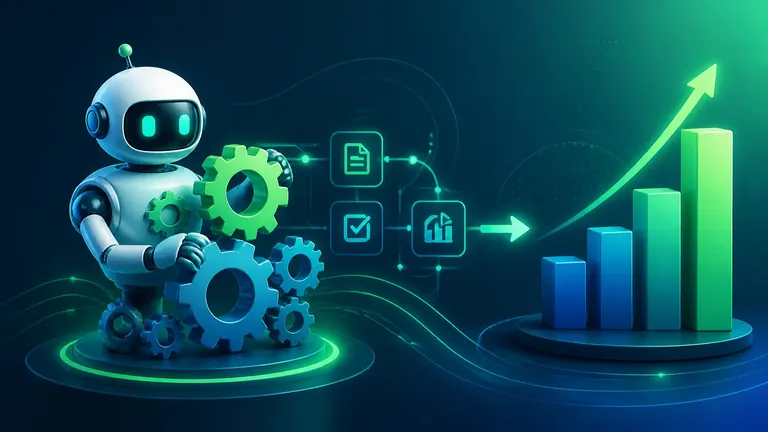
Growth Starts to Weigh Heavily When Operations Rely Too Much on Human Effort
Every company that begins to grow faces a similar moment. The volume increases, more leads come in, the sales team gains momentum, and operations finally seem to move out of instability. However, along with this progress, another problem begins to arise: everything starts to depend on constant monitoring.
Responding to contacts, updating CRM, remembering follow-ups, organizing stages, distributing opportunities, chasing returns, tracking negotiations. Gradually, growth stops feeling like expansion and starts to feel like overload.
The problem is not in the increase in demand.
It lies in the absence of a structure to handle it.
It is precisely at this point that commercial automation stops being just an operational tool and becomes a strategic part of growth.
Companies Don’t Lose Sales Just Due to Lack of Demand
There is a very common belief within sales operations: if sales are not happening at the expected pace, the problem lies in generating opportunities. In some cases, this is true, but a large part of the losses occurs after the lead has already entered.
The contact takes too long to be responded to. The follow-up does not happen at the right moment. The lead cools off in the middle of the process. Information becomes scattered. The sales team loses context of the negotiation.
None of these problems seem serious in isolation.
But together, they create a slow, exhausting operation that is extremely dependent on manual effort. And operations like this usually struggle to grow consistently.
Commercial Automation Is Not Just for Saving Time
When talking about automation, many people think only about productivity. Fewer repetitive tasks, less manual work, more operational speed.
All of this is part of it.
But the real impact of commercial automation lies elsewhere: it reduces friction within the sales journey.
When the process is automated correctly, the lead receives feedback faster, the sales team gains context of the opportunity, the stages are organized, and the operation starts to function with much less invisible loss.
This improves efficiency even before increasing conversion.
The Sales Team Begins to Change When It Stops Operating on Improvisation
A large part of sales teams operates in a highly reactive model. The day is guided by urgency, memory, pressure, and a backlog of operational tasks.
In this scenario, even good salespeople end up losing efficiency.
Because the problem is not just in individual skill. It is in the operational environment that requires constant effort to maintain minimal organization.
Automation changes precisely that.
It creates a process where there was once improvisation. It ensures that important activities no longer depend solely on the memory or manual discipline of the team. And this completely transforms the rhythm of the operation.
Excessive Effort Often Hides a Lack of System
There is a common trap in sales companies: believing that growth depends only on working harder.
More calls, more messages, more contacts, more pressure on the team. However, in many cases, the increase in effort is merely compensating for an inefficient structure.
When operations rely too much on human energy to function, they become difficult to sustain.
Commercial automation does not eliminate human work. It eliminates operational waste so that human effort can be used where it truly generates impact.
This is the most important point.
Efficient Automation Improves Predictability
Another important effect of automation appears in the ability to generate predictability.
When the commercial process is structured, the company begins to understand better:
- where leads get stuck,
- how long each stage takes,
- which opportunities advance faster,
- and which actions really impact conversion.
This creates operational clarity.
And operational clarity allows for more controlled growth.
Companies that automate correctly do not just gain speed. They gain the ability to interpret their own commercial process with much more precision.
The Mistake of Automating a Disorganized Operation
However, there is a frequent problem: trying to automate before structuring.
When a company has a confusing funnel, unclear criteria, and misaligned communication, automation does not solve the problem. It merely accelerates disorganization.
That is why efficient commercial automation depends on strategy.
It needs to stem from a well-designed process, a coherent journey, and a clear logic of conversion. Without this, technology becomes just a larger volume of automatic actions without direction.
The Market Is Moving Towards Smarter and Less Operational Operations
The companies that are growing the most today are not necessarily those with larger teams.
They are the ones that can operate more intelligently.
This means reducing repetitive tasks, increasing response speed, integrating data, improving the context of the journey, and allowing the sales team to focus more on decision-making and less on manual operation.
Commercial automation is part of this transformation.
And increasingly, it is ceasing to be a differential to become a basic structure for growth.
Conclusion: Commercial Efficiency Does Not Arise from Infinite Effort. It Arises from Process
Every commercial operation has a limit when it relies solely on human effort.
At some point, growth begins to pressure the system, and what once seemed to work starts to generate wear, slowness, and loss of efficiency.
Commercial automation exists precisely to solve this point.
It organizes processes, reduces operational waste, and allows companies to grow without turning expansion into overload.
In the end, it is not just about selling more.
It is about creating an operation capable of sustaining growth consistently.
Kaizen Helps Companies Structure More Efficient Commercial Operations
If your company is already generating leads, has a sales team, and feels that operations are becoming heavy as it grows, perhaps the problem is not in demand — but in the absence of a more intelligent system.
Kaizen connects automation, AI, funnel, and commercial process to transform manual operations into more efficient and predictable structures.
If you want to reduce operational effort and increase commercial efficiency without losing quality in the process, talk to Kaizen and discover how to structure your operation to grow with more control.