
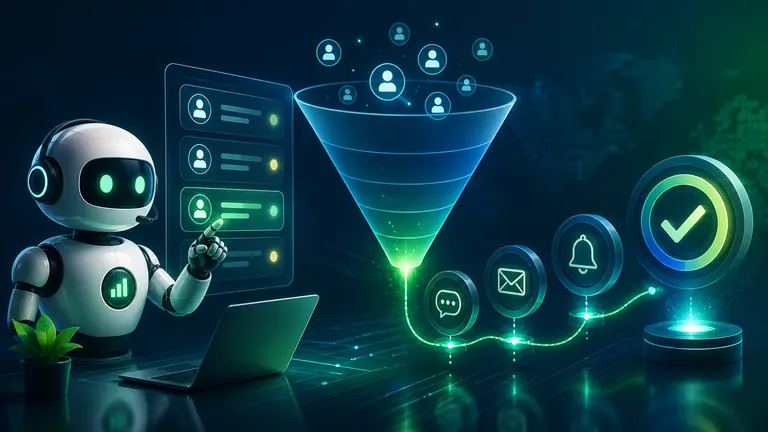
Artificial intelligence has moved from promise to operational reality in commercial areas. In 2026, the term dominating sales leaders' conversations is AI agents — autonomous systems that perform tasks in the sales cycle without direct human intervention. But what exactly are these agents? How do they differ from the chatbots we already know? And, most importantly, how can your company implement them to generate real results?
What is an AI agent in sales?
Unlike a traditional chatbot — which follows pre-programmed conversation flows — an AI agent is a system that makes decisions, executes actions, and learns from results. It not only answers questions: it qualifies leads, schedules meetings, sends personalized follow-ups, and even negotiates basic terms.
Think of the AI agent as a digital SDR (Sales Development Representative). It does the heavy lifting of prospecting and qualifying, freeing your human team to focus on what really matters: closing deals. This integration between automation and the sales team is the foundation of an integrated marketing and sales funnel that is efficient.
According to Gartner, by 2028 more than 60% of B2B commercial interactions will be initiated or mediated by AI agents. Kantar reinforces that “agentic AI” — AI with the ability to act — is the most transformative trend for marketing and sales this decade.
How do AI agents operate in the sales cycle?
1. Prospecting and lead qualification
The agent analyzes databases, social networks, and buying intent signals to identify leads with the highest likelihood of conversion. It scores, classifies, and prioritizes automatically — without spreadsheets. This process is the basis of hyper-personalization with AI, delivering the right message at the exact moment.
2. Intelligent follow-up
Forget generic email sequences. The AI agent personalizes each follow-up based on the lead's behavior: whether they opened the email, clicked the link, or visited the pricing page. The tone, timing, and contact channel adapt in real-time.
3. Scheduling and nurturing
Integrated with the CRM and the seller's calendar, the agent finds times, sends invitations, and nurtures the lead with relevant content until the right moment in the sales conversation.
4. Predictive analysis
With historical data and machine learning, the agent predicts closing probability, average cycle time, and even churn risk before the customer cancels. This predictive approach is part of what we call optimization for generative AI (GEO), where quality data feeds better decisions.
Available tools and technologies
The market for AI agents in sales has exploded. Some relevant categories include:
- SDR Agent Platforms: solutions that automate prospecting, qualification, and follow-up at scale (like SDR Agent by Kaizen)
- CRMs with native AI: HubSpot, Salesforce, and Pipedrive already incorporate AI agents that suggest next actions, draft emails, and score leads
- Conversational tools: agents that handle WhatsApp, website chat, and social media with negotiation capabilities
- Orchestration platforms: systems that coordinate multiple agents working at different stages of the funnel
How to implement in your company: a practical roadmap
Weeks 1-2: Diagnosis
- Map your current sales process: where are the bottlenecks?
- Identify repetitive tasks that consume your team's time
- Define clear KPIs: response time, qualification rate, conversion by stage
Weeks 3-4: Tool selection
- Test 2-3 platforms with a subset of leads
- Prioritize integration with your current CRM
- Evaluate support in English and adaptation to the market
Month 2: Controlled pilot
- Run a pilot with 20% of the lead base
- Compare results: response time, engagement rate, scheduled meetings
- Collect feedback from the sales team
Month 3: Scale
- Expand to the entire operation
- Create monitoring dashboards
- Establish continuous improvement cycles: the agent learns, but needs human supervision
What AI agents DO NOT replace
It is important to be clear: AI agents enhance, not replace, salespeople. They excel at:
- Repetitive and scalable tasks
- Processing large volumes of data
- Availability 24/7
But they still rely on humans for:
- Complex negotiation and relationship building
- Reading emotional nuances and politics
- Strategic and creative decisions
- Closing high-value contracts
Real results
Companies that have implemented AI agents in sales report:
- 40-60% reduction in response time to leads
- 25-35% increase in qualification rate
- 15-20 hours/week savings per salesperson
- Average ROI of 3-5x in 6 months
Conclusion
AI agents in sales are not the future — they are the present. Companies that adopt this technology now are building a competitive advantage that will be hard to achieve later. The secret is not to replace people, but to give them superpowers.
At Kaizen, we help companies structure intelligent sales processes — from automated prospecting to AI-assisted closing. Talk to us to discover how an AI agent can transform your sales.