
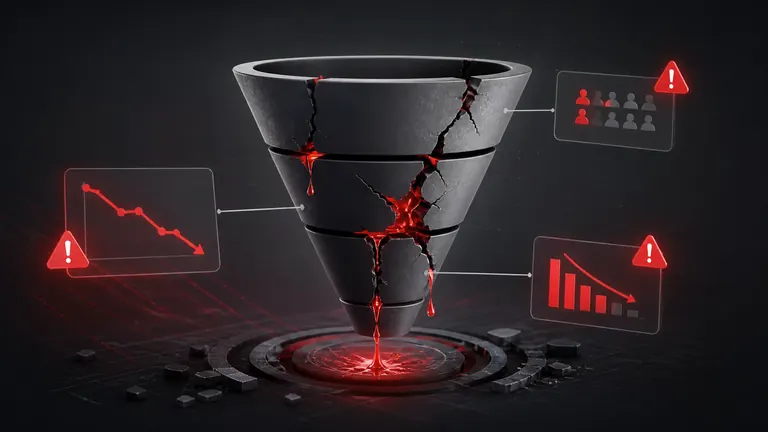
The problem isn't the lack of leads — it's what happens next
There is a pattern that repeats in many companies that already invest in marketing: the incoming numbers seem reasonable, the volume of leads exists, the campaigns are running, but growth does not keep pace. The feeling is one of constant effort without consistent progress. And, almost always, the initial interpretation is misguided — it is believed that there is a lack of volume, when in fact there is a lack of transformation.
Also read about: What is a sales funnel and how to organize it in your company?
The sales funnel does not stop functioning when it is broken. It continues generating movement, feeding the sales team and creating the impression that the system is active. The problem is more subtle: it loses efficiency along the way. Opportunities enter, but do not evolve smoothly. Progress depends on manual effort, insistence, and often the individual capacity of the salesperson. This is not structured growth — it is operational compensation.
Growing the top with a misaligned funnel increases the cost of error
One of the clearest signs that something is wrong appears when the company decides to scale. Investment increases, the volume of leads grows, and yet the final result does not keep pace. At times there are spikes, but they do not sustain. What should be a proportional relationship between input and output becomes unstable and unpredictable.
This type of behavior is often attributed to superficial factors: creative, channel, segmentation. The campaign is adjusted, a new format is tested, the pitch is changed. But these changes rarely solve the problem because it is not in the input — it is in the journey. When the funnel is not prepared to absorb volume, each new lead carries with it an increase in inefficiency. Scaling, in this scenario, does not accelerate growth. It only makes waste more visible.
Also read about: What is the role of content marketing in the sales funnel?
When the sales team needs to 'save' the sale, the funnel has already failed
Another sign appears in the internal dynamics of the company. In well-structured operations, the funnel is part of the work even before the commercial contact happens. The lead arrives with a minimum level of understanding, already recognizes the problem, and sees value in the solution. The salesperson's role is to guide, not to convince from scratch.
When this does not happen, the process reverses. The sales team takes on a corrective function. They need to explain too much, justify too much, rebuild the customer's perception from the beginning. Each sale requires elevated effort and the result becomes dependent on individual performance. This creates a false reading that the problem lies with the sales team, when in fact they are absorbing failures that should have been resolved earlier.
This type of operation may work in the short term, but it does not scale. Consistent growth requires that the process sustains the result — not that specific people carry the system.
The absence of predictability is the most costly symptom
Perhaps the most critical point of a misaligned funnel is the inability to predict. The company cannot respond confidently about how much it needs to invest to achieve a certain result, nor does it clearly understand where it is losing opportunities along the way. Decisions become based on trial and error, rather than structured reading.
Without predictability, any planning becomes fragile. Growth depends on specific moments, not on a replicable system. And, over time, this generates internal wear, pressure for results, and increased operational costs.
The problem is not just not knowing what is working. It is not knowing why it is not working.
Also read about: How can content marketing generate more leads?
The most common mistake is to insist on input and ignore the process
In light of this scenario, the most common reaction is to continue investing at the top. Traffic is increased, the volume of campaigns is expanded, channels are diversified. There is a feeling that, with more opportunities, the result will come.
But this logic ignores an essential point: the funnel is the mechanism that transforms input into results. If this transformation is not structured, the increase in volume only intensifies the problem.
Correcting this requires a shift in focus. Instead of asking "how to generate more leads," the company needs to understand "how these leads are being guided." It is in this space, between input and closure, that growth is built — or lost.
Conclusion: growth stalls where the process fails
Companies rarely stop growing due to a lack of demand. What prevents them from advancing is the inability to transform that demand into results consistently. And this is not solved with more campaigns, more investment, or more commercial effort.
It is solved with structure.
The sales funnel is not a stage of marketing. It is the foundation of growth. When it is aligned, the result follows the effort. When it is not, any attempt to scale increases cost, complexity, and frustration.
Before thinking about growing more, perhaps the right question is another: is your funnel prepared to sustain that growth?
Kaizen structures funnels that truly convert
If your company already generates leads, invests in marketing, and still cannot transform that movement into predictable growth, the problem is probably not in the input — it is in the process.
Kaizen works by structuring performance-oriented funnels, connecting acquisition, qualification, commercial approach, and data to transform opportunities into results.
It is not about generating more volume, but about building a system that converts consistently.
If you want to understand where your funnel is failing and how to correct this strategically, talk to Kaizen and start transforming effort into real growth.